A printable food and symptom diary template, free, no sign-up
Most printable food diaries are a grid with a column for food and a column for symptoms, which is why most of them find nothing. This one is laid out for the method dietitians use: ingredients rather than dishes, a severity score on every symptom, the confounders that get mistaken for food, and a weekly page that asks the right question.
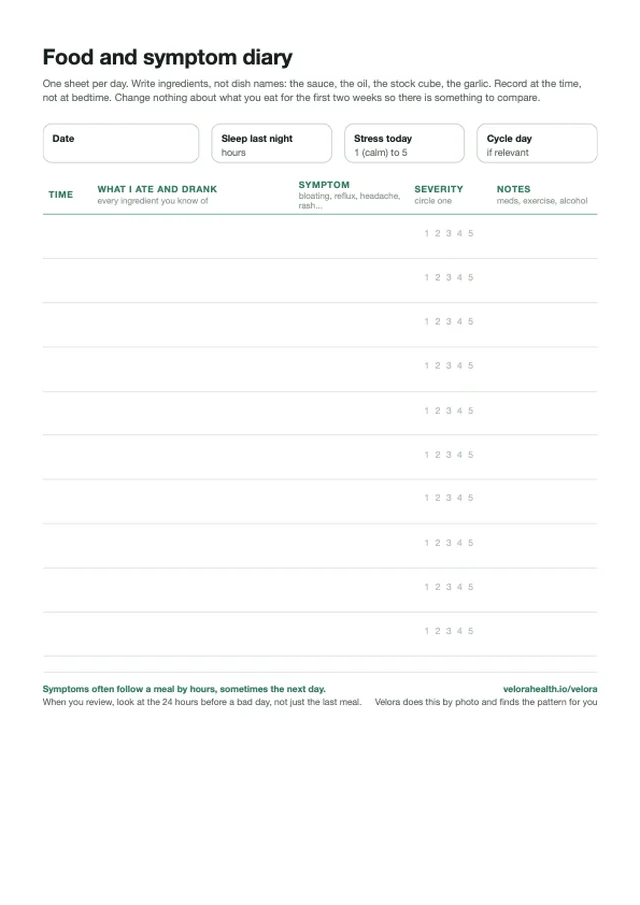
Two pages, A4 and US Letter friendly. Page one is a daily sheet to print as many times as you need. Page two is the weekly review. 70 KB, no sign-up and no email.
Download the food and symptom diary PDFPrinting is a fine way to start. When you get tired of doing the matching by hand, Velora does it from a photo of your plate.
What is on the two pages
Page one: the daily sheet
- Date, sleep, stress and cycle day at the top, because a bad night or a stressful day looks exactly like a bad meal in a diary that does not record them
- Time for every entry, since the gap between a meal and a symptom is the clue most diaries throw away
- What I ate and drank, with the instruction to write every ingredient you know of. Sauces, oils, stock, garlic, sweeteners
- Symptom and a 1 to 5 severity to circle, so days can be compared instead of just ticked
- Notes for medication, exercise and alcohol
Page two: the weekly review
This is the page other templates do not have. For each day you mark the worst symptom and its severity, then for the bad days you list what the 24 hours before contained. Not the last meal: the previous day, because intolerance reactions commonly lag by hours and sometimes overnight. At the bottom is space for a short suspect list, with the rule printed next to it: test one at a time, and reintroduce to confirm.
From paper to automatic
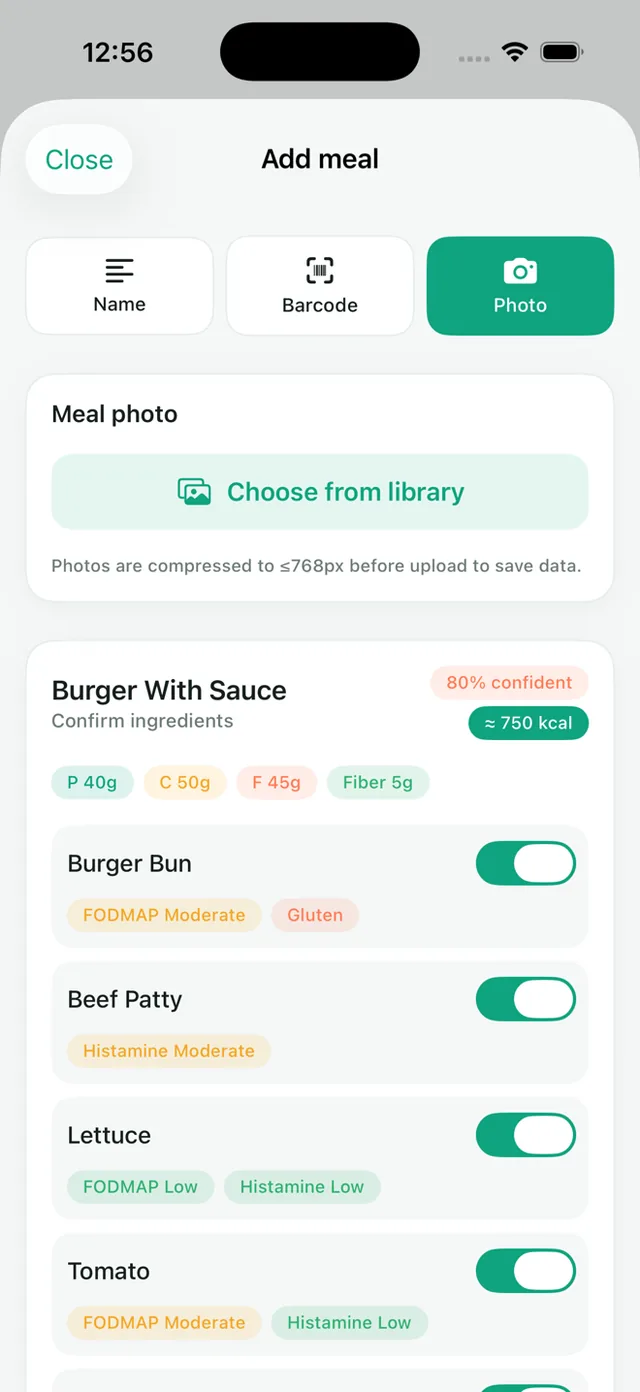
Paper is where almost everyone starts, and for the first fortnight it is the better tool. What changes is week three. By then the sheets are a stack, the question is no longer what did I eat but what do the bad days have in common, and that comparison has to be done by eye across twenty pages. Here is what each column of this template turns into in Velora, the iPhone app this site makes, line for line.
| On paper you write | In Velora |
|---|---|
| Everything you ate, ingredient by ingredient | Photograph the meal and the app lists the ingredients, including the ones you would not have written down. Or type the dish name and pick from 1,600+ dishes that come with their ingredients and calories |
| The symptom and a severity from 1 to 5 | Two taps: pick what you feel, pick how strong |
| What did I eat in the hours before this? | Every symptom is already linked to the meals before it, from 30 minutes to 12 hours for most and up to 24 for symptoms that typically lag, on a timeline you scroll |
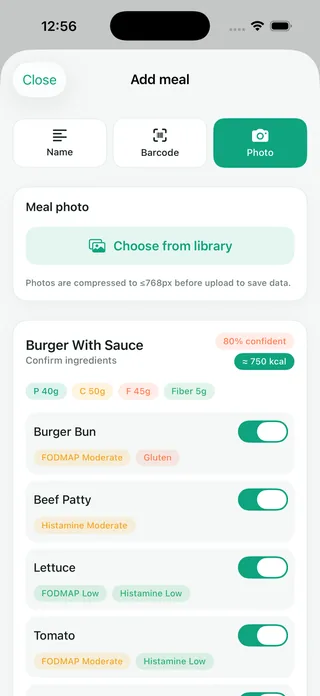
| Your suspect list at the end of the week | The app computes which foods came before your symptoms more often than chance would explain, on your device, and updates it as you log |
| Sleep, stress and cycle day at the top of the sheet | Fields on the day itself, kept alongside the meals |
| Notes for medication, alcohol, exercise | Medications, supplements and water are their own entries, not a margin note |
| The weekly review page | A weekly recap written for you (Premium) |
| Taking the sheets to your doctor or dietitian | A PDF report with your date range, your charts, your flare episodes and your suspect table, ready to print or send (Premium) |
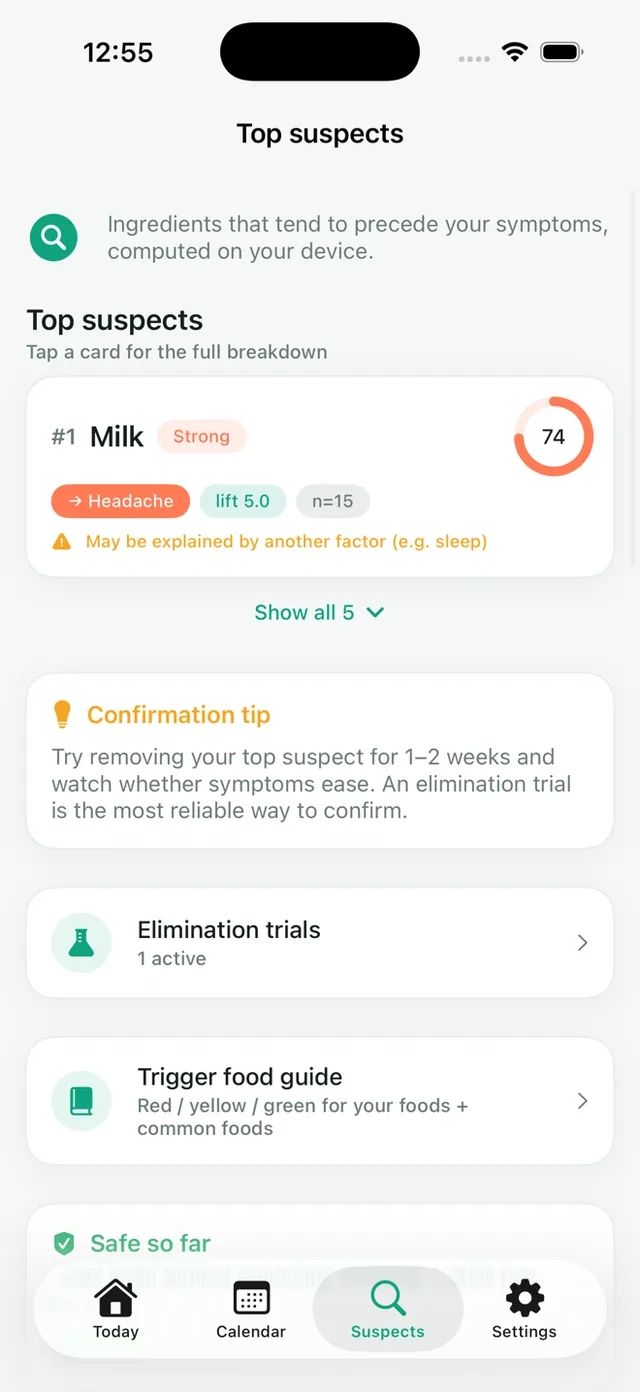
Everything in that right-hand column is in the free version except the two lines marked Premium. Velora is an iPhone app, with an Apple Watch app and a home screen widget, in English and German. Premium is monthly or yearly, and new subscribers start with a 7-day free trial.
How to use it
- Print one daily sheet per day. Two weeks is the minimum, and you should change nothing about your diet during them
- Fill it in at the time, not at bedtime. Memory rewrites what was in the sauce
- At the end of each week, complete the review page from the daily sheets
- When a suspect emerges, remove only that one food for two weeks, then eat it again deliberately. Symptoms returning is the evidence
- Take the sheets to your appointment. Four weeks of records is worth more to a GP or dietitian than any description from memory
The full method, including how to read the sheets without fooling yourself, is in how to keep a food and symptom diary. If your symptoms are mainly gut ones, the IBS version of the method adds what to do about FODMAP categories.
The limits of paper, honestly
Two things a printed sheet cannot do. It cannot tell you what was in a meal you did not cook, so hidden ingredients stay hidden. And it leaves the pattern matching to you, across pages, from memory, with all the bias that brings. Neither is a reason to avoid paper. Both are worth knowing before you conclude from four weeks of sheets that nothing is going on.
When paper is enough
More often than app makers like to admit. For a short trial of a week or two, a printed sheet starts faster than any app and there is nothing to learn. If you would rather not have a phone out at the table, if you are recording on behalf of someone else, or if a clinician asked you to bring something written to an appointment next week, print the sheets and ignore the rest of this page. The method is what does the work here, not the medium. This template was laid out to record the same things either way, so a fortnight on paper is not wasted if you do move to an app later.
Frequently asked questions
Is the food and symptom diary template really free? +
Yes. It is a PDF you can download directly from this page, with no email address or sign-up. Print as many daily sheets as you need.
What size paper is it for? +
It is laid out for A4 and prints correctly on US Letter with the default fit-to-page setting.
How many days should I fill in? +
At least fourteen without changing your diet. That gives enough good and bad days to compare and allows for reactions that lag a meal by a day.
Why does the template ask about sleep and stress? +
Because poor sleep and stress produce many of the same symptoms as food, and a diary that does not record them will blame a meal for a bad night.
Can I use it for IBS or reflux specifically? +
Yes. The severity column and the 24 hour review work for any symptom. For IBS it helps to note FODMAP categories in the notes column, which the IBS guide on this site explains.
This article is general wellness information from Velora Health, not medical advice, diagnosis or treatment. Always consult a qualified healthcare professional about your symptoms and before changing anything about your care.