Signs of congestive heart failure in dogs, and the number that warns you early
Congestive heart failure sounds like something that happens all at once. Usually it does not. In most dogs it announces itself quietly, in a number you can measure at home, days before the cough or the collapse that finally sends people to the vet. Knowing what to watch turns an emergency into a routine appointment.
The early signs of congestive heart failure in dogs are a rising resting breathing rate, a soft cough that is worse at night or after lying down, tiring sooner on walks, and restlessness at night. The breathing rate is the one you can measure: a sleeping dog normally breathes under 30 breaths per minute, and a sustained rise above that is often the earliest warning. Fast and laboured breathing, blue or pale gums, or collapse is an emergency.
First, the signs that mean go now
Some signs are emergencies, not things to monitor. Get to a vet or an emergency clinic immediately if your dog has fast and labored breathing at rest, is breathing with the belly heaving or the elbows pushed out, has blue, grey or very pale gums, collapses or faints, or cannot settle and cannot lie down because breathing is easier standing up. These can mean the lungs are filling with fluid, and that is treatable, but only quickly.
What congestive heart failure actually is
Heart failure is not the heart stopping. It is the heart no longer keeping up, so pressure backs up behind it. In the most common canine form, driven by mitral valve disease, a leaky valve lets pressure build back into the lungs, and fluid starts to seep into the air spaces. That fluid is why the earliest changes are all about breathing, and why breathing is the thing worth watching.
The early signs, roughly in the order they appear
- A rising resting or sleeping breathing rate. Usually the first measurable change, and the reason for this whole article. More below.
- A soft cough, often at night or after lying down, sometimes described as trying to clear something.
- Tiring on walks she used to manage, stopping sooner, or wanting to turn back.
- Restlessness at night, changing position, pacing, not settling.
- Faster breathing after mild effort that takes longer than usual to come down.
- A belly that looks more swollen, in the right-sided form, from fluid rather than fat.
No single one of these is proof of heart failure on its own. A cough has many causes, and an older dog slows down for many reasons. What matters is the pattern, and the one sign you can put an actual number on.
Why the resting breathing rate is the early-warning number
When fluid begins to build in the lungs, breathing speeds up to compensate, and it does so at rest and during sleep before your dog looks unwell. Veterinary cardiologists lean on this so heavily that the sleeping respiratory rate has become the standard at-home monitor for dogs with heart disease. A healthy dog asleep breathes comfortably under about 30 breaths per minute. A sustained climb above that, or a clear rise from your own dog's usual baseline even while still under 30, is the signal that fluid may be accumulating.
The power of it is the lead time. A breathing rate that drifts from the low twenties to 28, then 32, then 36 across a few days is often the earliest evidence there is, arriving before the cough that most owners are waiting for. Catching that trend can mean a medication adjustment at a normal visit instead of an oxygen cage overnight.
How to measure it, briefly
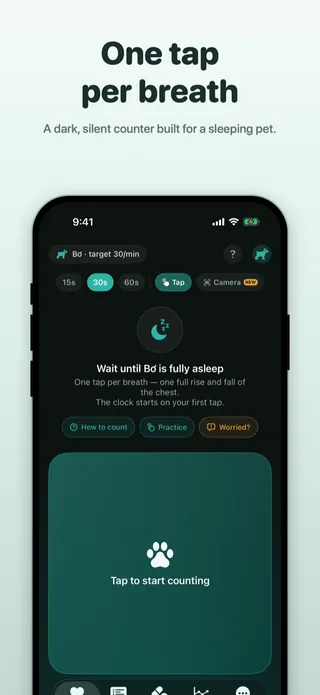
Count while your dog is asleep and not dreaming, since twitching throws the number off. Watch the chest: one rise plus one fall is one breath. Count for 30 seconds and double it, or a full minute for accuracy. Do it at about the same time each day and write it down, because the trend is the whole point and memory is not reliable at these numbers. We cover the technique in detail in our guide to counting a sleeping breathing rate.
Breeds and dogs at higher risk
Mitral valve disease is especially common in small breeds such as Cavalier King Charles Spaniels, Chihuahuas, Miniature Poodles and Dachshunds, and it becomes more likely with age. Larger breeds are more prone to a different disease of the heart muscle. If your dog is in a high-risk group, a known baseline breathing rate is worth having before anything is wrong, so a change is obvious the moment it happens.
What your vet does with the number
Treatment for congestive heart failure usually centres on removing the excess fluid and supporting the heart, often with a diuretic and a medication such as pimobendan, adjusted to how your dog responds. The home breathing count is how that adjustment gets guided between visits: a trend creeping up can prompt an earlier check or a dose change, and a trend that settles is reassurance the current plan is holding. Never change a heart medication yourself; the number is information for the conversation, not a prescription.
Turning a scary diagnosis into a daily habit
A heart failure diagnosis is frightening, and the instinct is to watch your dog constantly for the dramatic sign. The calmer and more useful thing is a ten-second count each evening while she sleeps, logged as a trend you and your vet can both read. PawBeat exists to make exactly that effortless: a silent counter that works in the dark, an alert at the threshold your vet sets, and a clean chart for the next appointment.
Frequently asked questions
What is the first sign of congestive heart failure in dogs? +
Most often a rising resting or sleeping breathing rate, which increases as fluid begins to build in the lungs and does so before the cough or exercise intolerance many owners wait for. A healthy sleeping dog breathes under about 30 breaths per minute, so a sustained rise, or a clear climb from your dog's own baseline, is an early warning to report to your vet.
How fast do dogs with heart failure breathe? +
Faster than their own healthy baseline. Vets treat a sustained sleeping breathing rate above about 30 breaths per minute, or a clear rise from a dog's normal, as a sign that fluid may be accumulating. The trend over days matters more than any single count.
Is my dog's heavy breathing an emergency? +
Fast breathing that is also labored, with the belly heaving, elbows out, or blue, grey or pale gums, or a dog who collapses or cannot lie down to rest, is an emergency. Go to a vet or emergency clinic immediately. Calm, comfortable fast breathing that you have measured as a trend is a reason to call your vet promptly rather than to panic.
How long can a dog live with congestive heart failure? +
It varies widely with the cause, the stage at diagnosis and how well fluid is controlled, so it is a question for your own vet rather than a number from an article. What is consistent is that catching fluid build-up early, often through the home breathing rate, supports better day-to-day control.
Can PawBeat diagnose heart failure? +
No. PawBeat makes the resting breathing-rate monitoring your vet prescribed easier and turns it into a clear chart. Diagnosis and all treatment decisions belong to your veterinarian.
What are the end stage signs of congestive heart failure in dogs? +
Laboured or fast breathing even at rest, restlessness and inability to settle at night, fainting or collapse, coughing, a swollen belly, loss of appetite and pale, grey or blue gums. Breathing difficulty at rest or a colour change in the gums needs emergency care. Your vet can advise on comfort and quality of life.
Can a dog with heart failure breathe normally at rest? +
Yes. When heart failure is well controlled with medication, many dogs have a normal sleeping breathing rate. That is exactly why the rate is tracked at home: a rise from that controlled baseline is often the first sign that treatment needs reviewing.
This article is general information from Velora Health, not veterinary advice, diagnosis or treatment. Always consult your veterinarian about your pet's symptoms and before changing anything about their care.