Sleeping respiratory rate in dogs and cats: normal range and how to count it
If your dog or cat has heart disease, your vet has probably asked you to count their breathing rate while they sleep. It sounds almost too simple to matter. It is actually one of the most valuable things you can do at home - because a rising sleeping breathing rate is often the earliest sign that heart failure is getting worse, days before other symptoms appear.
A sleeping dog or cat normally breathes under 30 breaths per minute, and most healthy pets sit in the high teens to low twenties. One rise and fall of the chest counts as one breath. A sleeping rate that stays above 30, or that climbs steadily away from your pet's own usual number, is a reason to call your vet.
Normal sleeping respiratory rate: the numbers
Your vet may call it the sleeping respiratory rate, the resting respiratory rate or simply the breathing rate - they all mean the same measurement, taken while your pet is genuinely asleep. Veterinary cardiologists rely on it because nothing else is inflating the number at that moment: no walk, no stress, no heat. The threshold below is the one used in veterinary cardiology guidance for dogs and cats with heart disease, and it is the same number most vets give owners for home monitoring.
| Breaths per minute while asleep | What it usually means |
|---|---|
| Under 20 | Comfortably normal for most dogs and cats. |
| 20 to 29 | Still in the normal range. Learn your pet's own usual number inside this band. |
| 30 to 39 | Above the threshold vets use. Call your vet, especially if it stays there across two or three days. |
| 40 to 59 | Clearly abnormal for a sleeping pet. Contact your vet the same day. |
| 60 or more | Urgent. Seek veterinary care now, particularly with any visible effort or open-mouth breathing in a cat. |
Two cautions on reading that table. First, your pet's own baseline matters more than the threshold: a dog that normally sleeps at 16 and now sleeps at 28 has nearly doubled, even though 28 is still technically normal. Second, the number alone is not the whole picture - fast breathing that also looks like work is a different situation, covered further down.
Is 50 breaths per minute normal for a sleeping dog?
No. Fifty breaths per minute in a genuinely sleeping dog is well above the normal range and should be treated as a same-day reason to contact your vet, even if your dog seems otherwise comfortable. Before you act on it, though, rule out the three things that most often produce a falsely high count: your dog was dreaming rather than in quiet sleep, was panting, or the room was warm. Let them settle, wait for calm closed-mouth sleep, and count again. If the number holds near 50, call. The same reasoning applies to cats, where a rate that high is if anything more concerning.
Do dogs breathe slower when sleeping?
Yes. Breathing is at its slowest and most regular in quiet sleep, when nothing is pushing the rate up: no activity, no excitement, no heat. That is exactly why vets ask for the sleeping rate rather than the awake one. It is the cleanest version of the number, and the one that shows a change first.
Dreaming is the exception. During dream sleep a dog may twitch, paddle, whimper and breathe in quick irregular bursts. Wait for that to pass before counting, or you will record a number that means nothing.
Is 12 breaths a minute normal? And is 60 bad?
Twelve breaths a minute in a sleeping dog is normal for many healthy dogs, and some large, deeply relaxed dogs sleep in the low teens or below. A slow sleeping rate is not a concern on its own. It becomes one only alongside something else: weakness, collapse, pale or blue gums, or a dog that is hard to rouse.
Sixty breaths a minute in a sleeping dog is not normal. At rest it is roughly double the threshold vets use, and it is a same-day call to your vet at the least. If the breathing also looks like work, the gums are pale or blue, or your dog cannot settle, treat it as an emergency. Rule out dreaming, panting and a hot room first, then recount once.
How many breaths per minute does a dog with heart failure take?
There is no single figure, because it depends on the dog and how well the condition is controlled. What veterinary cardiologists use is a threshold: a sleeping rate consistently above about 30 breaths a minute, or a clear rise from the dog's own baseline, is treated as a possible sign that fluid is building up. Dogs on treatment for heart failure are usually given a personal number to watch for by their vet, and that number takes priority over any general one.
Why the sleeping breathing rate matters so much
When a diseased heart starts to fail, fluid can begin backing up into or around the lungs. Breathing gets faster to compensate - and this shows up at rest and during sleep before your pet shows obvious distress. Veterinary cardiologists consider a sleeping breathing rate consistently under about 30 breaths per minute normal for dogs and cats; a sustained rise above your pet's usual baseline, even below that threshold, is worth reporting. Catching the trend early can mean adjusting medication at a routine visit instead of an emergency one.
How to check a dog's respiratory rate
- Wait until your dog is fully asleep - not just resting, and not dreaming (twitching or paddling skews the count)
- Watch the chest: one rise plus one fall equals one breath
- Count for 30 seconds and double it, or count a full 60 seconds
- Record the number with the date and time
Count at roughly the same time each day when you can. Panting does not count - wait for calm, closed-mouth sleep. In warm weather, note the heat, since it can nudge the number up. If your dog is deep-chested or thickly coated and the movement is hard to see, rest a hand lightly on the ribs rather than guessing from across the room.
How to count a cat's breathing rate
The method is the same, but cats make it harder in two specific ways. Their chest movement is much subtler than a dog's, so watch the flank just behind the ribs rather than the front of the chest, and get level with your cat instead of looking down at them. And purring makes an accurate count impossible - the breathing pattern changes completely - so if your cat starts purring when you come near, wait for a deeper, quieter sleep phase and try again.
Cats also hide illness far better than dogs do, which is exactly why the number matters: a cat can look completely normal at a rate that already concerns a cardiologist. Count on ordinary days, not only on worrying ones, so you know what your own cat's normal looks like.
The mistakes that ruin the data
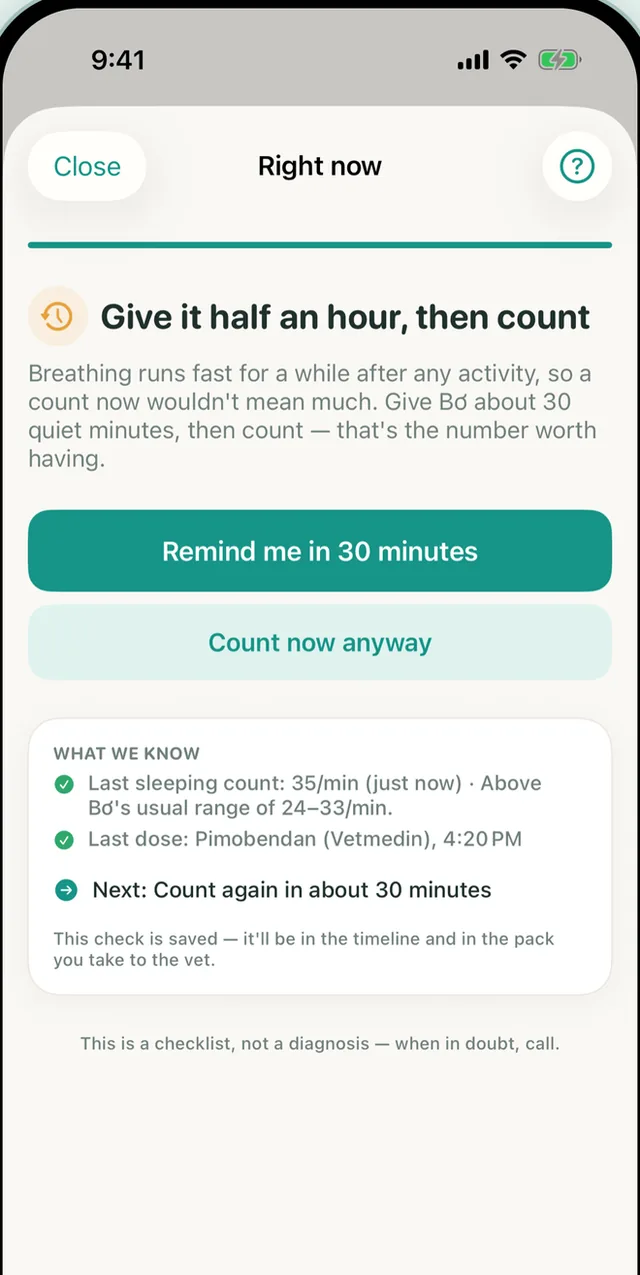
- Counting while the pet is awake or just drowsy - rates are naturally higher
- Counting during a dream phase
- Rounding or guessing instead of timing properly
- Counting only when your pet seems off - you need the normal days for a baseline
Track the trend, not single numbers
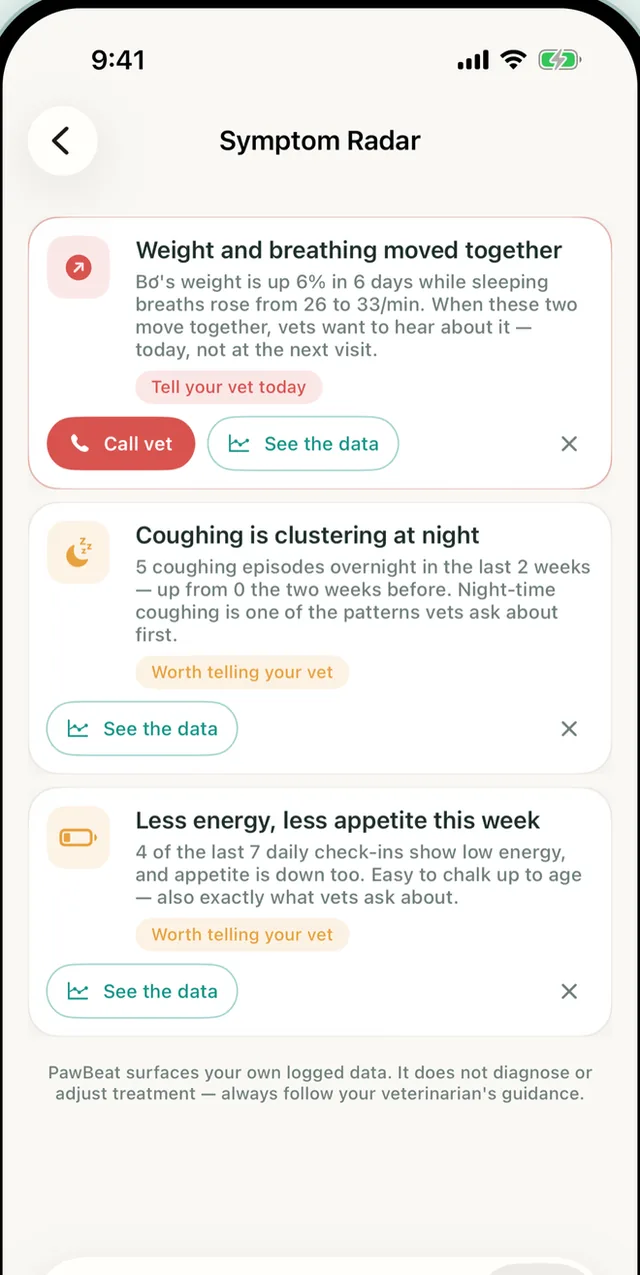
One high reading can be a dream or a hot evening. What matters is the pattern across days: a baseline in the low twenties that drifts to 28, 31, 34 over a week is a signal, even though no single number looks dramatic. This is why a chart beats a sticky note - and why vets ask for a log, not an impression.
What about heart rate while sleeping?
Breathing rate is the number vets ask for at home, because it is easy to measure accurately and it is the one that tracks fluid building up in the lungs. Heart rate is useful context, but it varies far more with breed and body size, so there is no single threshold like the 30 used for breathing.
| Pet | Typical resting or sleeping heart rate |
|---|---|
| Large or giant breed dog | Around 60 to 100 beats per minute |
| Medium dog | Around 70 to 120 beats per minute |
| Small dog or puppy | Around 100 to 140 beats per minute |
| Cat | Around 140 to 220 beats per minute; often at the lower end, near 140 to 180, when genuinely relaxed at home |
Cats measured at the vet almost always read high because of stress, which is exactly why a calm reading taken at home is worth having. If you want one, feel for the heartbeat low on the left side of the chest just behind the elbow, or find the femoral pulse on the inside of the thigh, then count for 15 seconds and multiply by four.
Why a dog's heart rate slows and speeds while sleeping
If you have counted a sleeping dog's heart and noticed it slowing down and then picking back up in a repeating cycle, that is usually respiratory sinus arrhythmia - the rate rises slightly as the dog breathes in and falls as it breathes out. In dogs this is normal and is generally a sign of a healthy, relaxed nervous system. It is most obvious at rest and during sleep, which is when people tend to notice it and worry.
Cats are different: they do not normally show this pattern, so a clearly irregular rhythm in a sleeping cat is worth mentioning to your vet rather than assuming it is the same harmless thing. And in either species, a resting heart rate that is persistently far outside the ranges above, or a rhythm with skipped or chaotic beats, belongs in a conversation with your vet - a home count cannot tell you what a rhythm actually is.
Know your action threshold
Ask your vet what number should prompt a call for your specific pet - commonly it is a sleeping rate consistently above 30, or a clear sustained rise from baseline. Agree on it in advance, write it down, and set an alert. If breathing is rapid and labored, or your cat is open-mouth breathing, treat it as an emergency.
Related reading: why a cat breathes fast and the signs of congestive heart failure in dogs, if the count is what brought you here.
Make it effortless, make it shareable
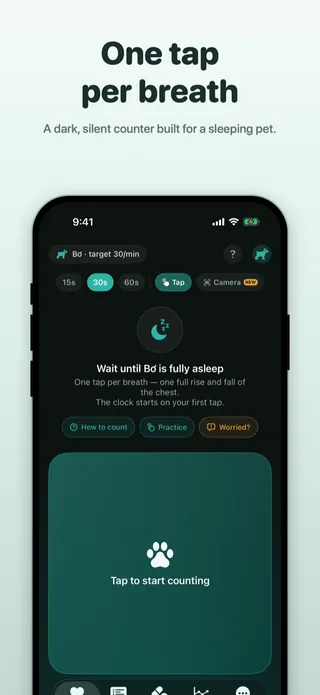
The count only works if it happens daily, often in a dark room with one hand on a sleeping animal. A silent tap-to-count tool that works in the dark, alerts you at your vet's threshold, and turns the log into a clean chart for appointments removes every excuse. That is exactly what PawBeat does.
Frequently asked questions
What is a normal sleeping breathing rate for dogs and cats? +
Veterinary cardiologists generally consider under about 30 breaths per minute normal for sleeping dogs and cats, with many healthy pets in the high teens to low twenties. Your own pet's baseline is the most useful reference - ask your vet what threshold should trigger a call.
Is it normal for a dog to breathe 50 times a minute while sleeping? +
No. Fifty breaths per minute in a truly sleeping dog is well above the normal range and is a same-day reason to contact your vet. First rule out a falsely high count: dreaming, panting, or a warm room will all inflate the number. Wait for calm, closed-mouth sleep and count again. If it stays near 50, call your vet.
How do I count my cat's breathing? +
Wait until your cat is fully asleep and not dreaming, then watch the chest and count one rise plus one fall as a single breath. Count for 30 seconds and double it, or count a full 60 seconds. Do it at a similar time each day so the readings are comparable.
What is a normal heart rate for a cat while sleeping? +
Cats generally run about 140 to 220 beats per minute, and a genuinely relaxed cat at home is often nearer the lower end, around 140 to 180. Readings taken at the vet are usually higher because of stress, which is why a calm home count is useful context.
Why does my dog's heart rate slow down when sleeping? +
A dog's heart rate normally rises slightly on the in-breath and falls on the out-breath, a pattern called respiratory sinus arrhythmia. It is most noticeable at rest and during sleep, and in dogs it is normal and generally a sign of a healthy, relaxed nervous system. Cats do not usually show it, so an irregular rhythm in a cat is worth mentioning to your vet.
How often should I count? +
For pets with diagnosed heart disease, most vets ask for a daily count, ideally at a similar time. Consistency is what makes the trend meaningful.
What if my pet will not stay asleep? +
Count during their deepest sleep window, often late evening. If they wake, just try again later - a missed day is better than a bad reading taken while awake.
Does PawBeat replace vet visits? +
No. PawBeat makes the monitoring your vet prescribed easier and turns it into a clear report. All treatment decisions belong to your veterinarian.
Do dogs breathe slower when they sleep? +
Yes. Breathing is slowest and most regular in quiet sleep, which is why vets ask for the sleeping rate. Dream sleep is the exception: twitching and irregular bursts of breathing are normal then, so wait for quiet sleep before counting.
Is 12 breaths per minute normal for a sleeping dog? +
Yes, for many healthy dogs, and some large relaxed dogs sleep lower still. A slow rate is only a concern alongside weakness, collapse, pale or blue gums, or difficulty waking.
Is 60 breaths per minute bad for a dog? +
At rest or asleep, yes. It is about double the threshold vets use and warrants a same-day vet call, or emergency care if breathing looks laboured or the gums are pale or blue. Rule out dreaming, panting and heat first, then recount.
How many breaths per minute is a dog with heart failure? +
There is no single figure. Vets treat a sleeping rate consistently above about 30, or a clear rise from the dog's own baseline, as a warning sign, and dogs on heart medication are usually given a personal threshold to watch.
This article is general wellness information from Velora Health, not medical advice, diagnosis or treatment. Always consult a qualified healthcare professional about your symptoms and before changing anything about your care.