Why is my dog coughing at night? How to tell a heart cough from an airway cough
A cough that only shows up at night, or a few minutes after your dog settles down, is worth paying attention to. Owners usually assume a chest infection or something caught in the throat. Sometimes it is. But a cough with that particular timing is also one of the ways heart disease announces itself, and the two are told apart less by how the cough sounds than by what else is happening at the same time.
A cough that appears at night or shortly after lying down, and comes with a sleeping breathing rate above 30 breaths per minute, points towards the heart rather than the airway. An airway cough is usually harsh and honking, happens on excitement or pulling against a collar, and leaves the resting breathing rate normal. Coughing with fast, laboured breathing or blue or pale gums is an emergency.
Why heart coughs happen at night
When the left side of the heart cannot move blood forward efficiently, pressure builds back into the vessels of the lungs and fluid begins to seep into the lung tissue. Lying down redistributes that fluid and removes gravity's help, which is why the cough so often arrives once the dog settles, or in the small hours. Standing up, moving around and sitting upright ease it, which is also why a dog with a heart cough may get up and reposition repeatedly through the night.
An enlarged heart can also press upward on the main airway that runs above it, and that mechanical irritation produces a cough of its own. Either way, the timing is the clue: airways do not care what position your dog is in, and hearts do.
Heart cough or airway cough?
| Points towards the heart | Points towards the airway | |
|---|---|---|
| When | At night, or minutes after lying down | On excitement, on a walk, pulling against a collar |
| Sound | Softer, moist, sometimes ending in a swallow or a gag | Harsh, dry, honking; a goose-honk suggests the windpipe |
| Resting breathing rate | Usually raised, often above 30 | Normal between coughing fits |
| Stamina | Tiring sooner, wanting shorter walks | Unchanged |
| Position | Better standing or propped up, worse lying flat | No clear pattern |
| Other signs | Restless nights, belly looking fuller, gums duller | Often after kennels, a new dog, or dusty air |
No single row settles it, and plenty of dogs have both a heart problem and an irritable airway. The row that carries the most weight at home is the breathing rate, because it is the only one you can put a number on.
Count the sleeping breathing rate before you call
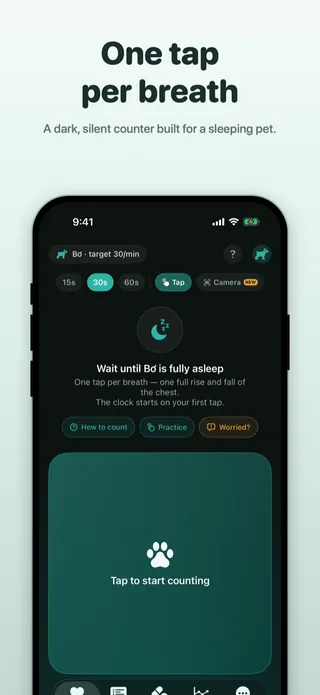
This is the single most useful thing you can do before the appointment. Wait until your dog is properly asleep, watch the chest, and count one rise plus one fall as a single breath for 30 seconds, then double it. Under 30 is normal. A dog whose cough is coming from the heart will usually be running above that, and a dog with a purely airway cough usually will not.
Do it on several nights rather than once. A vet can act on "he has coughed at night for nine days and his sleeping rate went from 22 to 34 across that time" in a way they cannot act on "he has been coughing a bit." The full method is in our guide to counting a sleeping respiratory rate.
When it is an emergency, not a phone call
Go to a vet or an emergency clinic now if the coughing comes with breathing that is fast and laboured at rest, a belly that heaves with each breath, elbows held away from the body, blue, grey or very pale gums, collapse or fainting, or a dog who cannot settle and will not lie down because breathing is easier standing. Coughing up pink or white froth is also an emergency. These can mean fluid is filling the lungs, which is treatable, but only quickly.
What else causes a night cough
- Kennel cough and other infections. Usually harsh and honking, often after contact with other dogs, and the resting breathing rate stays normal.
- Collapsing trachea. Classic goose-honk, common in small breeds, triggered by excitement or a collar.
- Chronic bronchitis. A long-running cough in a middle-aged or older dog, often worse in dusty or smoky air.
- Lungworm or other parasites. Worth ruling out depending on where you live.
- Something inhaled. Sudden onset in a previously well dog, often with retching.
Only a vet can separate these, usually with a stethoscope and a chest x-ray. What you bring to that appointment decides how quickly they get there.
Coughing when lying down
A cough that starts soon after your dog lies down is one of the patterns vets pay most attention to. In a dog with heart disease, lying flat can make it easier for fluid to affect the lungs, and an enlarged heart can press on the airway, so the cough appears when the body settles. That is why a cough tied to lying down belongs with a sleeping breathing count before anything else.
It is not the only explanation. A collapsing trachea can be set off by a change of position or by pressure on the throat, and dogs with airway inflammation often cough when they first lie down and again when they get up. The breathing rate is what helps separate them: a normal sleeping rate makes a heart cause less likely, and a raised one makes it more likely.
Coughing and gagging at night
A cough that ends in a gag or a retch is extremely common, and it often makes owners think something is stuck. Dogs frequently gag at the end of a coughing bout simply because the cough has cleared mucus into the throat. Kennel cough, bronchitis and tracheal collapse all commonly produce this pattern.
It is also easy to confuse with reverse sneezing, a loud snorting inward breath in bursts that looks alarming but is usually harmless and stops on its own. A short video of an episode settles which one you are dealing with far faster than a description.
Coughing all night but acting normal during the day
A dog that seems bright and active by day but coughs through the night is a common and genuinely confusing picture. Normal daytime behaviour is reassuring about some causes but not about heart disease, which is exactly the condition most likely to show itself at night and at rest first. Count the sleeping breathing rate on two or three nights and book a vet visit either way, because a cough that persists night after night deserves a diagnosis rather than a guess.
Small breeds and older dogs
Two groups come up again and again. Small and toy breeds, such as Yorkshire terriers, Chihuahuas, Pomeranians and toy poodles, are prone to tracheal collapse, and many small breeds, Cavalier King Charles spaniels especially, are also prone to a leaking heart valve that can lead to heart failure. Older dogs of any breed are more likely to have heart disease or chronic bronchitis. In either group a new night cough is worth taking to the vet promptly.
What to write down before the appointment
- The time of day the coughing happens, and whether lying down sets it off
- Your dog's sleeping breathing rate across several nights
- How many separate coughing episodes a night, roughly
- Whether walks have got shorter or slower
- A short video of an episode, because the cough almost never happens in the consulting room
That last one matters more than owners expect. Vets rarely get to hear the cough themselves, and a ten-second clip removes all the guessing from a description.
Making the count something you actually keep up
Counting breaths at midnight, in the dark, with one hand on a sleeping dog, is exactly the kind of task that gets abandoned by the third night. PawBeat turns it into a silent tap counter that works in the dark, and its overnight Night Log listens while your dog sleeps and keeps a two-second clip of anything that stands out, so in the morning you confirm what each one was. The cough count you take to the vet is then one you verified yourself, not a number an app guessed.
Frequently asked questions
Why does my dog cough at night but not during the day? +
Lying down redistributes fluid in the chest and removes gravity's help, so a cough driven by heart disease often appears once the dog settles or in the small hours. An enlarged heart can also press on the airway above it. Airway problems such as kennel cough or a collapsing trachea usually do not follow that position pattern.
How do I know if my dog's cough is heart related? +
The most useful home test is the sleeping breathing rate. Count one rise and fall of the chest as a breath, over 30 seconds doubled, while your dog is properly asleep. Under 30 is normal. A cough that comes with a sleeping rate consistently above 30, tiring sooner on walks and restless nights points towards the heart; a harsh honking cough with a normal resting rate points towards the airway.
Is a dog coughing at night an emergency? +
It becomes an emergency when the coughing comes with breathing that is fast and laboured at rest, a heaving belly, elbows pushed out, blue, grey or pale gums, collapse, an inability to lie down, or coughing up pink or white froth. Go to a vet or emergency clinic immediately. A cough on its own, with a normal resting breathing rate, is a prompt appointment rather than a dash.
What does a heart cough sound like in a dog? +
Owners usually describe it as softer and moister than a kennel cough, sometimes ending in a swallow or a gag as though something is stuck. It is not reliable on its own, though, because dogs vary and some heart coughs sound harsh. The timing and the resting breathing rate separate the two far better than the sound does.
Should I record the cough for my vet? +
Yes. The cough almost never happens in the consulting room, and a ten-second video removes the guesswork from your description. Bring the video along with your sleeping breathing rate readings from several nights.
Why does my dog cough when lying down? +
A cough triggered by lying down can be a sign of heart disease, because the heart can press on the airway and fluid can affect the lungs when the body settles. Collapsing trachea and airway inflammation can do it too. Counting the sleeping breathing rate helps your vet tell them apart.
Why is my dog coughing and gagging at night? +
Gagging at the end of a coughing bout is common and usually means mucus has been cleared into the throat, not that something is stuck. Kennel cough, bronchitis and tracheal collapse often cause it. Reverse sneezing can look similar, so a short video helps your vet.
My dog coughs all night but acts normal. Should I worry? +
It is worth a vet visit. Acting normal during the day does not rule out heart disease, which often shows at night and at rest first. Count the sleeping breathing rate over a few nights and bring those numbers.
Why is kennel cough worse at night? +
Many coughs seem worse at night because lying down, a quieter room and waking from sleep make coughing bouts more noticeable. A night cough in a dog with a raised sleeping breathing rate, or in a small or older dog, should not be assumed to be kennel cough without a vet check.
This article is general information from Velora Health, not veterinary advice, diagnosis or treatment. Always consult your veterinarian about your pet's symptoms and before changing anything about their care.