How long does a fibromyalgia flare last, and what the research found
Most pages answer this with days to weeks and move on. There is better information than that, from a study that followed people for six months and asked them to describe every flare, and the number it produced is longer than almost anyone expects.
In the one prospective study to characterise flares, three quarters of patients had at least one flare in six months, with a mean of two flares each and a mean duration of eleven weeks. That is a clinic sample and a mean, so it describes the group rather than your next flare: plenty of flares last days. The practical use of it is permission to stop assuming a long flare means you are doing something wrong.
What the study measured
Researchers recruited 124 people with fibromyalgia from outpatient clinics and followed them for at least six months, asking them to note and describe any worsening of symptoms (Reumatologia, 2022). Sixty-nine of them, about three quarters of those followed, reported at least one flare. The mean was two flares per person and the mean duration was eleven weeks.
Two cautions before that number does any work. A mean is pulled upward by long flares, so the typical flare in that group was almost certainly shorter than eleven weeks. And people recruited from outpatient clinics are, by definition, people whose fibromyalgia is bad enough to be in clinic. Someone managing well at home is not in the sample.
What people reported setting them off
| Trigger | Share of patients reporting it |
|---|---|
| Continuous stress | 56% |
| Intense stress | 39% |
| Physical overexertion | 37% |
| Climatic changes | 36% |
Stress in two forms at the top, and the fact that they were measured separately matters: a long grinding stretch and a single hard event were reported as different triggers by different people. What patients did about flares was mostly rest and medication.
Why your flares may look nothing like that
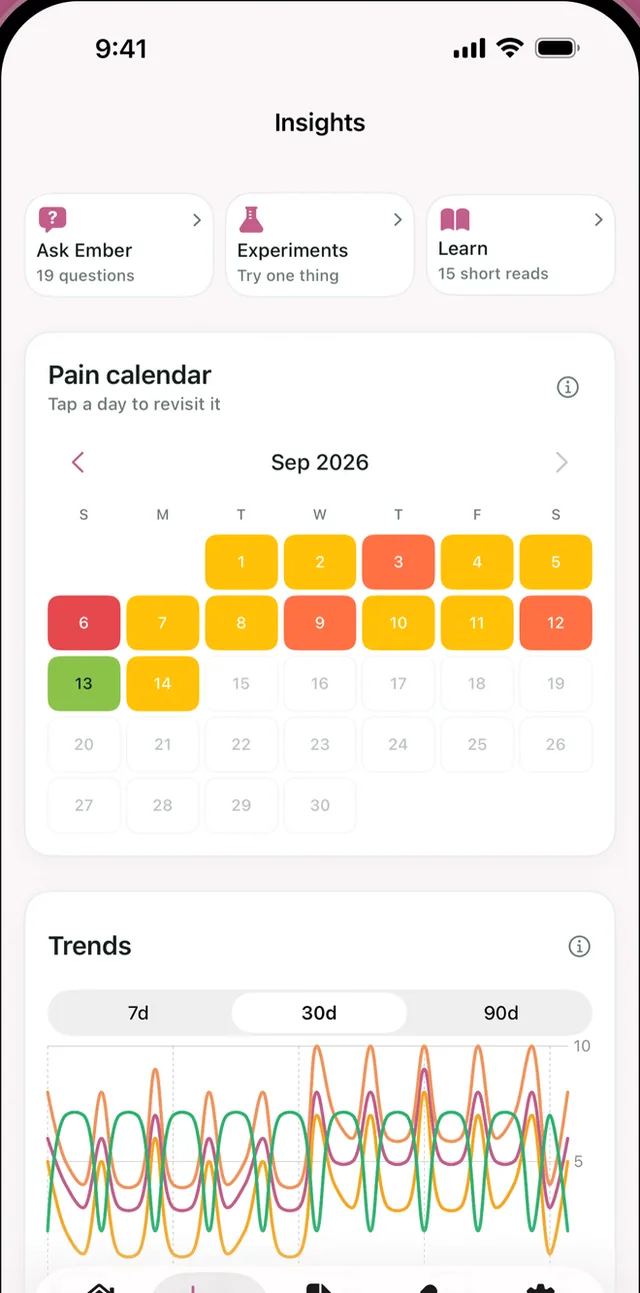
Fibromyalgia has no test that tells you a flare has started or finished, so the boundary is drawn by the person living in it. Someone who calls any bad week a flare will count many short ones. Someone who only names a flare when they cannot work will count a few long ones. Both are reasonable and they produce completely different numbers, which is most of why published figures disagree.
The part that is actually under your control
Not the length, which is the uncomfortable answer. What people can usually influence is how early a flare is recognised and whether the push and crash cycle extends it. The pattern is familiar: a good day arrives, the backlog gets cleared, and the following three days are lost. Pacing on good days is unglamorous and it is the intervention with the most support behind it.
What to record, given that nothing is objective here
- The start date, which is the single thing memory loses first and the one a rheumatologist asks for. There is a free printable fibromyalgia flare diary with a page for this
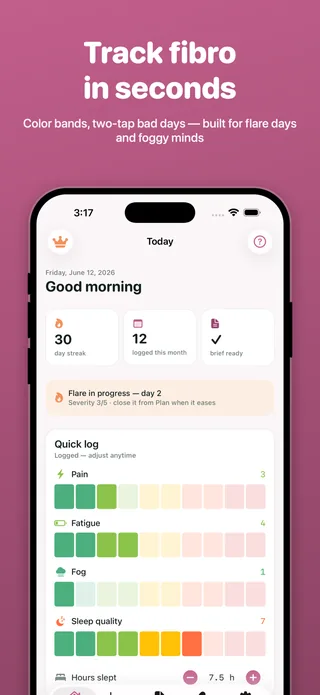
- Pain, fatigue and cognitive fog separately, because they do not move together and the worst one differs between flares
- Sleep, since poor sleep both precedes and follows flares and the direction is impossible to recall later
- Activity on the days before, which is how a push and crash pattern becomes visible rather than theoretical
- A validated score now and then, such as the revised Fibromyalgia Impact Questionnaire, so a change over months is measured rather than remembered
The method, designed so it survives a bad day, is in how to track fibromyalgia symptoms without draining yourself, and what the symptoms are doing underneath is in why fibromyalgia causes fatigue and pain.
Frequently asked questions
How long does a fibromyalgia flare last? +
In a prospective study of 124 people followed for six months, flares lasted a mean of eleven weeks, and three quarters of patients had at least one flare with an average of two each. A mean is pulled up by long flares, so many flares are much shorter, and there is no objective marker that defines when one starts or ends.
Is it normal for a fibromyalgia flare to last months? +
It is more common than most pages suggest. In the study above the mean flare lasted eleven weeks, which means months-long flares were part of ordinary experience in that group. A flare that keeps extending is still worth raising with your clinician, because new symptoms and other conditions can hide inside one.
What triggers a fibromyalgia flare? +
In the same study patients reported continuous stress (56%), intense stress (39%), physical overexertion (37%) and climatic changes (36%). These are what people noticed and reported rather than proven causes, which is exactly why your own record is more useful than any general list.
How do I know if I am in a flare or this is my baseline? +
There is no test, so the comparison has to be with your own recent weeks. This is where a few months of simple daily ratings earns its keep: a flare is obvious against your own trend line and invisible against memory.
What helps shorten a fibromyalgia flare? +
Nothing reliably shortens one, which is worth saying plainly. What people report helping is rest, their usual medication, and avoiding the push and crash cycle where a good day gets overspent and costs the next three. Pacing is the intervention with the most support behind it.
Should I tell my doctor about every flare? +
Not every one, but bring the record. Frequency, length and what preceded them is what a rheumatologist can act on, and it is also what distinguishes fibromyalgia behaving normally from something new that deserves investigating.
This article is general wellness information about fibromyalgia, not medical advice. It does not diagnose fibromyalgia, which is a clinical assessment, and tracking is not treatment. New symptoms, or symptoms that do not fit the pattern you know, deserve a medical opinion rather than a place in a diary.