Why fibromyalgia causes pain and fatigue, in plain language
Being told your tests are normal while you are in pain every day is its own kind of injury. The current understanding of fibromyalgia actually explains that combination well, and knowing the explanation changes how you describe it and what you ask for.
Fibromyalgia is understood primarily as a disorder of how pain is processed rather than damage to the muscles or joints themselves. The nervous system amplifies pain signals, a mechanism usually described as central sensitisation. That is why the painful areas look normal on scans and why standard blood tests come back clear. Fatigue is a core feature rather than a side effect, and it is closely tied to unrefreshing sleep. It is a chronic condition, not a progressive or terminal one.
Pain without damage is still pain
In fibromyalgia the problem is largely in the signalling rather than the tissue. Pain thresholds are lowered, so stimuli that would be mildly uncomfortable register as painful, and pain that should fade continues. The two terms you will meet are hyperalgesia, where painful things hurt more, and allodynia, where things that should not hurt at all do, such as a waistband or a hug.
This is why a normal MRI is not reassurance in the way it is meant to be, and why the honest framing is that the tests were looking for something else. It also explains why the pain moves around and varies day to day in a way that structural damage does not.
Why the fatigue is not ordinary tiredness
People with fibromyalgia commonly wake unrefreshed regardless of hours slept, and sleep studies in fibromyalgia have shown disruption of deep sleep. The loop is unpleasant and self-reinforcing: poor sleep lowers pain thresholds further, more pain disrupts sleep further. This is why sleep is treated as part of the condition rather than as a separate complaint, and why it is worth reporting specifically.
The fatigue is also frequently more disabling than the pain, and is under-reported for the simple reason that the condition is described in terms of pain. If that is true for you, say it explicitly.
The cognitive part has a name
Word finding difficulty, losing the thread mid sentence, slowed thinking. It is widely called fibro fog and it is a recognised part of the picture rather than something you are imagining or a sign of something worse. It tends to track with sleep quality and pain levels, which is one reason recording all three together is more useful than recording any one alone.
What is known about why it starts
There is no single cause. It is frequently reported to begin after a physical trigger such as an infection, injury or surgery, or after a period of severe psychological stress, and it sometimes appears without an identifiable trigger at all. Family history is more common than chance, suggesting a genetic contribution to pain sensitivity. It also occurs more often alongside conditions such as irritable bowel syndrome and other chronic pain conditions.
What is not the case: it is not muscle or joint damage, it is not inflammatory arthritis, and it is not a psychological condition, though pain and mood affect each other in both directions as they do in any chronic pain condition.
How diagnosis works without a test
There is no blood test that confirms fibromyalgia. It is diagnosed clinically, usually with a widespread pain assessment and a symptom severity score, after excluding other conditions that can look similar such as thyroid disease, inflammatory arthritis and some autoimmune conditions. That is why the blood tests are still worth doing: they are ruling things out, not looking for fibromyalgia.
What is worth recording, given all of this
- Pain, with location, since the movement of it is itself informative
- Fatigue as its own number, not folded into pain
- Sleep quality rather than only hours
- Cognitive difficulty, on a simple scale
- What you did the previous day, because delayed payback after activity is common and is invisible in a single day's entry
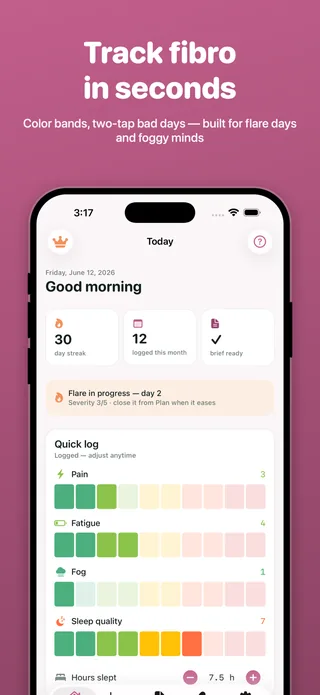
How long the bad stretches tend to run, and what a prospective study measured, is in how long a fibromyalgia flare lasts. Validated scales exist for this, including FIQR and the widespread pain index with symptom severity score, and clinicians recognise them. Weeks of those numbers say something that describing a bad day cannot. Ember records exactly these with two-tap logging built for low energy days, and produces a monthly visit brief.
Frequently asked questions
Why does fibromyalgia cause pain if tests are normal? +
Because the problem is largely in how pain signals are processed rather than in the tissue itself. The nervous system amplifies pain, a mechanism called central sensitisation, so scans of the painful areas look normal. Normal results rule out other conditions rather than ruling out fibromyalgia.
Why does fibromyalgia cause fatigue? +
Fatigue is a core feature, closely linked to unrefreshing sleep and disrupted deep sleep. It is self-reinforcing, since poor sleep lowers pain thresholds and increased pain further disrupts sleep. Many people find the fatigue more disabling than the pain.
Is fibromyalgia terminal? +
No. Fibromyalgia is a chronic condition that can be severely disabling, but it is not progressive in the sense of damaging the body over time and it does not shorten life. That distinction matters, and it is one of the most searched questions about it.
Is fibro fog real? +
Cognitive difficulty including word finding trouble and slowed thinking is a recognised part of fibromyalgia. It tends to vary with sleep quality and pain levels, which is a reason to record all three together.
What causes fibromyalgia to start? +
There is no single cause. It often follows a physical trigger such as an infection, injury or surgery, or a period of severe stress, and sometimes appears with no identifiable trigger. A family history is more common than chance would predict.
How is fibromyalgia diagnosed? +
Clinically, since no blood test confirms it. Assessment usually involves a widespread pain index and symptom severity score alongside tests that exclude conditions with similar presentations, such as thyroid disease and inflammatory arthritis.
This article is general wellness information from Velora Health, not medical advice, diagnosis or treatment. Always consult a qualified healthcare professional about your symptoms and before changing anything about your care.