What to eat during a diverticulitis flare, stage by stage
When a diverticulitis flare starts, the question that matters most is also the simplest: what can I eat right now? The usual answer is a photocopied sheet that says clear liquids, then low residue, with nothing about what that means for the food actually in your kitchen. Here is the fuller version.
First, the part that is not about food
Some symptoms need care today, not a diet plan. Severe or worsening abdominal pain, a fever, rectal bleeding, persistent vomiting, or being unable to keep liquids down all mean contacting your doctor or emergency services now. Diverticulitis can develop complications that need treatment rather than rest, and no article or app can tell you which situation you are in. If you are unsure, that uncertainty is itself a reason to call.
Why the diet changes in stages
During an acute flare, the usual approach is to reduce what passes through the inflamed segment of bowel, then gradually return to normal eating as symptoms settle. That is why the advice inverts the healthy-eating rules you know: fiber, which is the long-term goal, is the thing temporarily reduced.
How long each stage lasts depends on your case and your clinician's instructions. Milder cases are often managed at home, sometimes with antibiotics, sometimes without, following current guidance that not every uncomplicated case needs them.
Stage 1: clear liquids
Typically water, broth, clear juices without pulp, ice pops, plain tea or coffee without milk, and gelatin. This is meant to be brief, usually a few days at most, and it is not nutritionally adequate for longer. If you are not improving enough to move on within the timeframe your clinician gave you, that is a reason to check in rather than continue.
Stage 2: low-residue foods
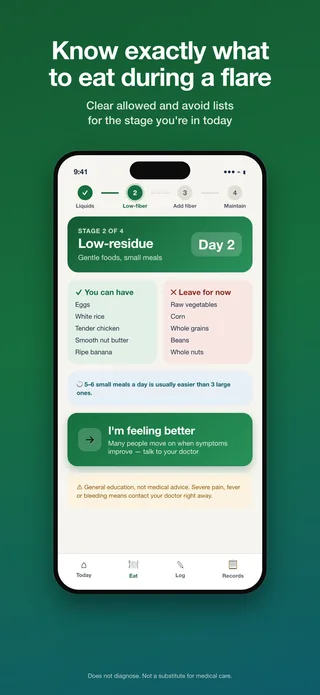
As symptoms improve, foods that leave little residue are usually added: eggs, white rice, white bread and pasta, tender cooked chicken or fish, well-cooked vegetables without skins, canned or cooked fruit, smooth nut butter, ripe banana. Smaller and more frequent meals are generally easier than three large ones.
Stage 3: fiber, gradually
Once you are comfortable, fiber comes back slowly. Adding it quickly commonly causes gas, bloating and cramping that can be mistaken for the flare returning, so the pace is the point. Increase gradually and drink more water as you do.
Between flares: the goal reverses
Long-term guidance for most people points toward a high-fiber diet, which is the opposite of what you were doing a fortnight earlier. This whiplash is the single most confusing thing about diverticulitis eating, and it is why a food list that ignores which stage you are in will mislead you about half the time.
The truth about nuts, seeds and corn
Many people were told to avoid nuts, seeds, popcorn and corn permanently, on the theory that fragments lodge in diverticula. Large prospective research has not supported that. A widely cited study following tens of thousands of men over many years found no increased risk of diverticulitis with nut, corn or popcorn consumption, and if anything found inverse associations.
Guidance from major centres has moved accordingly, and these foods are generally left out only during the temporary low-residue stage, not for life. If your own clinician has told you otherwise for a specific reason, follow them. But if the advice came from a leaflet decades ago and nobody ever revisited it, it is worth raising. The longer version, including where the rule came from and what the research actually measured, is in can you eat nuts, seeds and popcorn with diverticulitis.
Keep a record while it is happening
Flares blur together in memory, and the details that matter clinically are exactly the ones that fade: when it started, how long it lasted, whether you had antibiotics, whether it was confirmed on a CT scan, how many you have had this year. If a surgical conversation ever comes up, that history is the ground it is discussed on, and reconstructing it afterwards is guesswork.
Move on when you are ready, not on a schedule
Recovery is not a fixed timetable. The usual instruction is to advance as tolerated, which puts the judgement on you. Advancing because a chart says day four, while you still feel unwell, is not progress. Neither is staying on clear liquids for a week because nobody told you it was safe to stop. Both of those are conversations with your clinician rather than decisions to make alone at 2am.
For the shape most flares follow, and the point at which slow recovery stops being normal, see how long a diverticulitis flare lasts. If you were told you have diverticulosis rather than diverticulitis, the diet advice on this page is probably not the advice for you: the difference is explained here.
Frequently asked questions
What can I eat during a diverticulitis flare? +
Most guidance starts with clear liquids such as broth, water and pulp-free juice, then moves to low-residue foods such as eggs, white rice, tender chicken, well-cooked vegetables and ripe banana, then gradually reintroduces fiber. Your own clinician's instructions come first.
How long does the clear liquid stage last? +
Usually a few days at most, since it is not nutritionally adequate for longer. If you are not improving enough to progress within the timeframe your clinician gave you, contact them rather than continuing.
Do I have to avoid nuts, seeds and corn forever? +
Large prospective research has not supported lifelong avoidance, and a major long-term study found no increased risk from nuts, corn or popcorn. They are generally left out only during the temporary low-residue stage. If your clinician has advised otherwise for your case, follow them.
When should I go to the emergency room with diverticulitis? +
Seek urgent care for severe or worsening pain, a fever, rectal bleeding, persistent vomiting, or if you cannot keep liquids down. These can indicate complications that need prompt treatment. If you are unsure, call.
Should I eat more fiber or less? +
It depends entirely on the stage. Less during an acute flare, and more between flares, where a high-fiber diet is the usual long-term recommendation. This reversal is the most confusing part of diverticulitis eating and the reason a single food list cannot serve both situations.
This article is general information from Velora Health, not medical advice. It cannot tell you whether you are having a flare and it does not replace medical care. If you have severe or worsening pain, a fever, rectal bleeding, persistent vomiting, or you cannot keep liquids down, contact your doctor or your local emergency number now.