How long does a diverticulitis flare last, and when is slow a warning
You ask this on day three, when it still hurts and you are trying to work out whether this is how it is supposed to go. The honest answer is a shape rather than a number, and the useful part is knowing which stretches of that shape are expected and which are a signal.
For an uncomplicated flare treated at home, pain usually begins to ease within two to three days, and most people are largely settled within one to two weeks. Tiredness and an unsettled bowel often lag several weeks behind the pain. A flare that is not improving after two or three days, or that worsens at any point, is a reason to contact your doctor rather than wait. Complicated diverticulitis follows a different course and is managed in hospital.
Why there is no single number
Diverticulitis covers a wide range. At one end is a mildly inflamed segment managed at home with rest and a temporary diet change. At the other are complications such as an abscess or a perforation, which are a hospital matter and not on any of the timelines below. How quickly treatment started, whether antibiotics were used, how many episodes you have had before and what else you live with all move the clock.
The usual shape of an uncomplicated flare
| When | What usually happens | What is worth a phone call |
|---|---|---|
| Day 1 to 2 | Pain, most often in the lower left abdomen, with a change in bowel habit. Treatment starts | Severe or spreading pain, fever, rectal bleeding |
| Day 2 to 3 | Pain should be starting to ease | No improvement at all. This is the classic point to call back |
| Day 4 to 7 | Steady improvement, appetite returning, diet advancing as tolerated | Pain that returns after it had improved |
| Week 2 | Most people feel close to normal | Symptoms that plateau instead of resolving |
| Week 3 to 6 | Energy and bowel habit finish settling | Anything new, or anything that worries you |
These are typical patterns, not a prescription. Your own clinician's instructions and the timeframe they gave you come first, and if they said call in 48 hours, that is the number that applies to you rather than anything here.
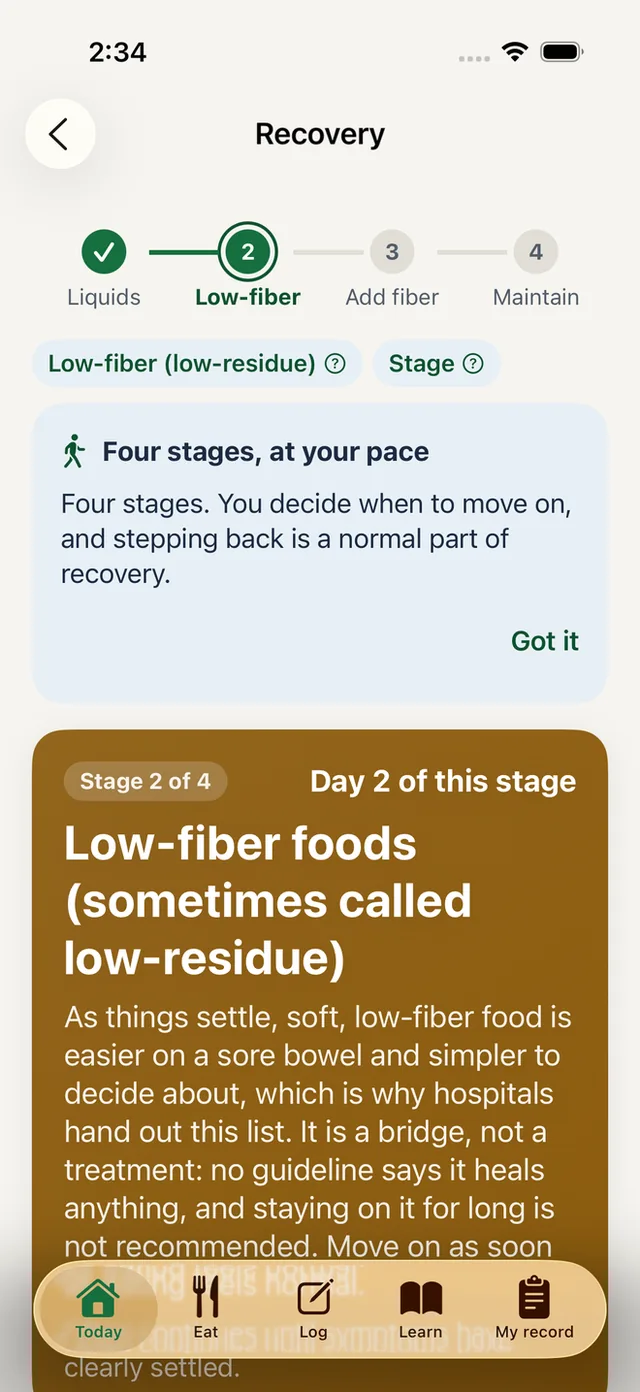
The parts that lag behind
Pain resolves first, and people take that as the finish line. Bowel habit and energy usually take longer, sometimes several weeks. Feeling flat and unreliable for a fortnight after the pain stops is a common experience and not by itself a sign the flare is still active, though it is worth mentioning at a follow-up rather than assuming.
What stretches a flare out
- A delay before treatment started. The most common reason a mild episode turns into a long one
- A complication such as an abscess, which does not resolve on rest and a soft diet
- Advancing the diet too quickly, which can produce symptoms that feel like the flare returning
- Repeated episodes, where recovery often feels slower each time
- Other conditions that affect healing or the bowel generally
Fibre coming back can look like a relapse
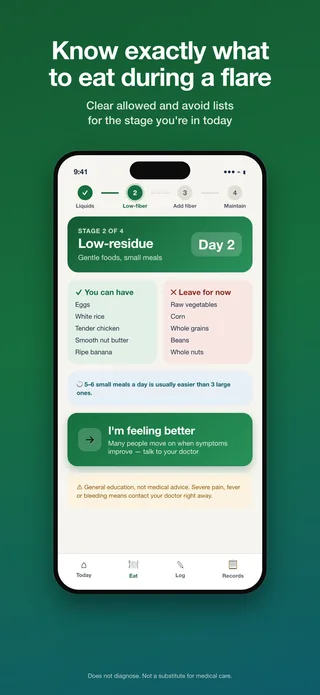
This one catches a lot of people. Fibre is the long-term goal, so it comes back as you recover, and adding it quickly causes gas, bloating and cramping. Those feel enough like the flare returning to be alarming. The difference is usually that a fibre reaction follows a specific meal and settles, while a returning flare builds and does not. If you cannot tell which you are looking at, that is a question for your doctor, not a judgement call to make alone. The pacing itself is covered in what to eat during a flare, stage by stage.
When the timeline is itself the red flag
Contact your doctor or emergency services if pain is severe or worsening, you have a fever, there is rectal bleeding, you are vomiting persistently or you cannot keep liquids down. Beyond those, the timeline has its own warning built in: an uncomplicated flare that has not begun to improve after two or three days of treatment is not a patience problem. It is a reason to be reassessed.
Can diverticulitis last for weeks or months?
An uncomplicated flare should not. Improvement within days and near-normal within a couple of weeks is the usual pattern, so symptoms that genuinely persist for many weeks are a reason to be reassessed rather than to wait longer. That does not always mean something serious. It does mean the explanation needs checking.
The possibilities a clinician will usually consider include a complication such as an abscess, an infection that has not fully cleared, a separate problem that was mistaken for a flare, and ongoing pain after the inflammation itself has settled, which some people do experience and which is managed differently from an active flare. Telling these apart usually needs an examination and often a scan, which is why describing it as a flare that has lasted two months is less useful to your doctor than giving them the dates.
How do you know a flare is over?
Pain is the first thing to resolve, and the one people use as the finish line. A more reliable picture is all three of these together: pain gone rather than just dulled, a normal temperature, and eating a widening diet without symptoms returning. Bowel habit and energy often take several more weeks to settle, and lagging on those alone is common after a flare.
Many people are advised to have a colonoscopy some weeks after an episode, particularly after a first one or if one has not been done recently, to rule out other causes. Your own team will tell you whether that applies to you.
When bowels go back to normal
Often later than the pain. Constipation, looser stools or an unpredictable pattern for a few weeks are common as fibre is reintroduced and the gut recovers from both the inflammation and any antibiotics. A gradual settling over several weeks is the usual course. Bleeding, a new pattern that does not settle, or unintentional weight loss are reasons to see a doctor rather than to keep waiting.
How long does the fatigue last
This is the part nobody is warned about, and the part that worries people most, because no discharge sheet puts a number on it. The common pattern is feeling noticeably flat for one to three weeks after the pain has gone, improving in steps rather than smoothly, then being tired by the middle of the afternoon for a while after that. Where there were several days of barely eating, broken sleep and a course of antibiotics, it tends to sit at the longer end.
There is a reason it trails the pain. The colon settling down is one process; days of poor intake, disturbed sleep and the general cost of an inflammatory episode are others, and they recover on their own schedule rather than the colon's. Going back to work on the day the pain stops is how a lot of people discover this.
What is not the usual pattern is fatigue that is deepening rather than lifting, fatigue with a fever, breathlessness or a racing heart, or fatigue that is unchanged well over a month later. Those are worth a check rather than more patience, not least because anaemia from bleeding and a pocket of infection that has not cleared can both look exactly like being worn out.
Does a flare last longer without antibiotics
For a selected group of people, the honest answer is that the timeline looks much the same either way, which surprises almost everyone who has been told antibiotics are the treatment. The American College of Physicians guideline, 2022 suggests managing most acute uncomplicated left-sided diverticulitis in an outpatient setting, and initially managing select patients without antibiotics, both as conditional recommendations on low-certainty evidence.
The clearest single piece of evidence behind that is the Swedish AVOD trial, which randomised 623 people with CT-confirmed uncomplicated diverticulitis to antibiotics or no antibiotics. Complications occurred in 1.0 per cent of those given antibiotics and 1.9 per cent of those not given them, a difference that was not statistically significant. Median hospital stay was three days in both groups, and at one year 16 per cent of each group had been readmitted with a recurrence.
The word carrying the weight in all of that is select. It describes people assessed as uncomplicated, usually on a scan, and well enough to be watched, which is a judgement made by someone who has examined you rather than a decision to take at home on day two. What the selection involves is set out in do you need antibiotics for a diverticulitis flare.
How long is a bout that needs hospital care
Complicated diverticulitis, meaning an abscess, a perforation, an obstruction or a fistula, is not a longer version of the timeline above. It is a different one. Intravenous antibiotics in hospital are usually a matter of days rather than weeks, an abscess may need draining, and the advice afterwards is normally several weeks of gradual recovery once home. Where surgery is involved, recovery is measured in weeks to months, and the surgical team's timeline replaces every number on this page.
Will it come back
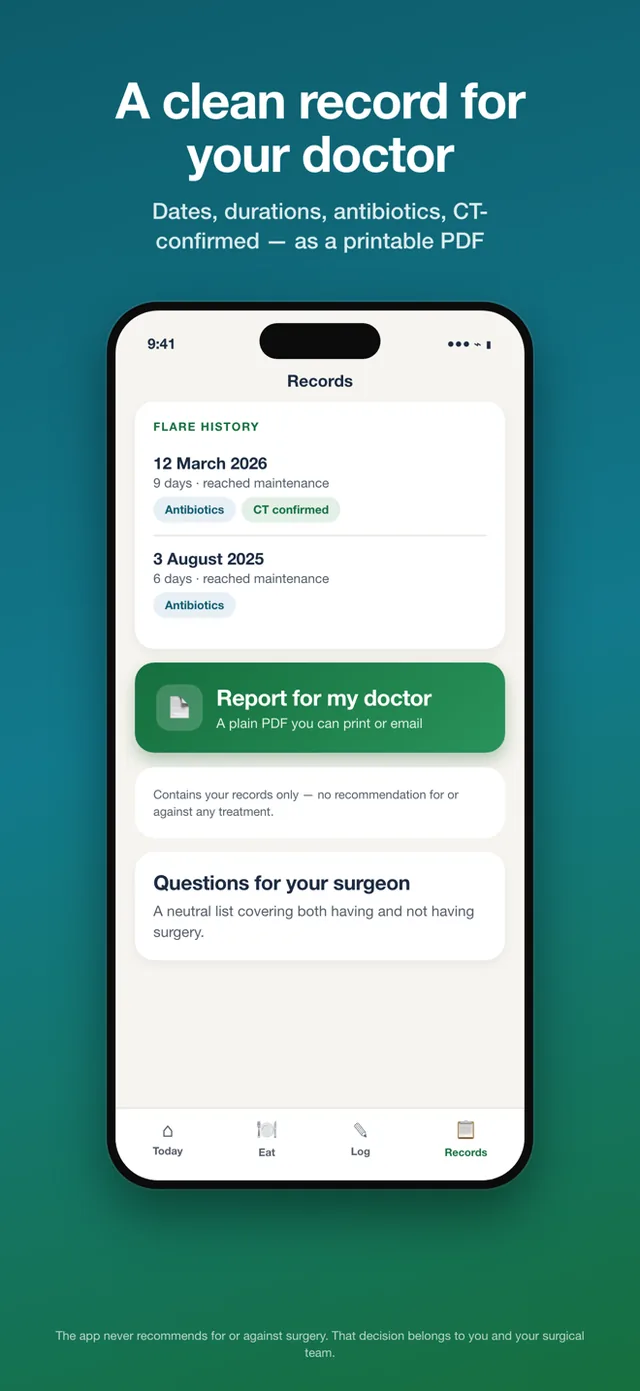
Often, but far from always. A recurrence after a first episode is common enough to plan around, with frequently cited figures in the region of one in five, and many people never have a second. What matters more than the odds is your own record: how many episodes, how far apart, how each was treated and whether any were confirmed on a scan. If a conversation about surgery ever happens, that history is the ground it is discussed on.
Why the dates are worth writing down
Flares blur together. A year later the honest answer to how many have you had is usually two or three, I think, and the details that carry clinical weight are exactly the ones that fade: the start date, when it settled, whether you took antibiotics, whether a CT confirmed it. Reconstructing that afterwards is guesswork, and it is guesswork in a conversation where the number of episodes matters.
Frequently asked questions
How long does a diverticulitis flare last? +
For an uncomplicated flare treated at home, pain usually starts to ease within two to three days and most people are largely settled within one to two weeks. Fatigue and an unsettled bowel often take several weeks longer. Complicated diverticulitis is managed in hospital and follows a different course.
How long does diverticulitis pain last after starting antibiotics? +
Improvement is generally expected within two to three days. If there has been no improvement at all by then, or symptoms are worsening, contact the clinician who prescribed them rather than finishing the course and hoping.
Why am I still tired weeks after a diverticulitis flare? +
Energy and bowel habit commonly lag behind the pain by several weeks. That pattern is familiar, but persistent fatigue is still worth raising at a follow-up rather than assuming it is just recovery.
Can a diverticulitis flare go away on its own? +
Some mild uncomplicated cases settle without antibiotics, and current guidance supports using them selectively rather than in every case. That decision belongs to a clinician who has assessed you, not to waiting at home to see.
How do I know if my flare is coming back or it is just fibre? +
A reaction to fibre usually follows a particular meal and settles. A returning flare tends to build and persist, and may bring fever. If you cannot tell, treat that uncertainty as a reason to call rather than a reason to wait.
Can diverticulitis last for months? +
An uncomplicated flare usually improves within days and settles within a couple of weeks, so symptoms lasting many weeks or months should be reassessed. Possible explanations include a complication, an infection that has not cleared, a different condition, or lingering pain after the inflammation has resolved, and telling them apart usually needs an examination and often a scan.
How long does diverticulitis pain last? +
In an uncomplicated flare pain typically starts to ease within two to three days of treatment and is gone or nearly gone within one to two weeks. Pain that does not improve after two or three days, or that returns after improving, is a reason to contact your doctor.
How do I know my diverticulitis flare is over? +
Look for pain that has gone rather than dulled, a normal temperature, and eating a widening diet without symptoms returning. Energy and bowel habit often take several more weeks to settle, which is common and not by itself a sign the flare is still active.
How long until bowel habits return to normal after diverticulitis? +
Often several weeks, and usually later than the pain resolves. Bleeding, a new pattern that does not settle, or unintentional weight loss should be checked by a doctor.
How long does fatigue last after diverticulitis? +
Feeling flat for one to three weeks after the pain has gone is the common pattern, improving in steps rather than smoothly, and being tired in the afternoons for a while after that is usual too. Fatigue that is deepening, comes with a fever, breathlessness or a racing heart, or is unchanged well over a month later should be checked rather than waited out.
How long does a bout of diverticulitis last? +
An uncomplicated bout treated at home usually starts to ease in two to three days and is largely settled in one to two weeks. A complicated bout, meaning an abscess, perforation, obstruction or fistula, follows a different course: intravenous antibiotics in hospital are typically days rather than weeks, with several weeks of gradual recovery afterwards, and longer again if surgery is involved.
Does a diverticulitis flare take longer to settle without antibiotics? +
Not for the selected group studied. In the AVOD trial of 623 people with CT-confirmed uncomplicated diverticulitis, median hospital stay was three days whether or not antibiotics were given, complications were 1.9 per cent without and 1.0 per cent with, and one-year recurrence was 16 per cent in both groups. Whether you are in that selected group is a clinical judgement, not a home decision.
Why does my diverticulitis flare up every month? +
Frequent repeated flares are worth a proper review rather than being treated one at a time. Some episodes turn out to be a different cause, and a record of dates, symptoms and how each was confirmed makes that review far more useful.
This article is general information from Velora Health, not medical advice. It cannot tell you whether you are having a flare and it does not replace medical care. If you have severe or worsening pain, a fever, rectal bleeding, persistent vomiting, or you cannot keep liquids down, contact your doctor or your local emergency number now.