Do you always need antibiotics for a diverticulitis flare?
For decades the answer was yes, automatically. It has quietly changed, and the change is easy to misread in both directions: it does not mean antibiotics are unnecessary, and it does not mean you can decide at home to skip them. Here is what the guidance actually says, what the evidence behind it found, and where the line sits.
Current guidance supports managing selected people with acute uncomplicated left-sided diverticulitis without antibiotics, and managing most of them at home rather than in hospital. Selection is the whole point: it depends on how the flare was assessed, usually with a scan, and on who you are, and it is a clinical judgement. Do not stop or skip a prescribed course on the strength of this page. Complicated diverticulitis, and anyone who is immunosuppressed, frail, pregnant or seriously unwell, is outside all of it.
A flare is inflammation, and not always much of an infection
The name points at the answer. Diverticulitis means inflammation of the pouches, not infection of them. What happens is mechanical first: a pouch becomes obstructed and irritated, the wall inflames, and in some people bacteria then play a significant part while in others they barely do. That spectrum is why two people can be given the same diagnosis and need quite different treatment.
It also explains something people find confusing, which is being told they have a flare while their temperature is normal and their bloods are only mildly off. That can be a genuine flare with very little infection in it. The opposite matters more: a fever, a high white cell count and a sharply raised CRP point toward a flare where antibiotics are doing real work.
What the guidance says now
The American College of Physicians clinical guideline, 2022 makes three conditional recommendations for acute left-sided colonic diverticulitis, each on low-certainty evidence: use abdominal CT when the diagnosis is uncertain, manage most uncomplicated cases in an outpatient setting, and initially manage select patients with uncomplicated disease without antibiotics. The AGA clinical practice update, 2021 reaches the same place from the gastroenterology side: antibiotics used selectively rather than routinely in uncomplicated disease.
Two words in there do a lot of work. Conditional means the panel is recommending this without strong evidence, so reasonable clinicians will differ. Select means the recommendation is about a subgroup, and identifying that subgroup requires assessment rather than self-assessment.
What the trials found
Two randomised trials are the reason any of this changed. Both enrolled people with CT-confirmed uncomplicated diverticulitis, which is worth holding on to: nobody has tested this approach in people whose flare was never imaged.
| Trial | What it compared | What it found |
|---|---|---|
| AVOD, Sweden and Iceland, 623 people | Antibiotics versus no antibiotics for CT-confirmed uncomplicated diverticulitis | Complications in 1.0 per cent with antibiotics and 1.9 per cent without, not statistically significant. Median hospital stay three days in both groups. Recurrence needing readmission at one year 16 per cent in both groups |
| DIABOLO long-term, Netherlands, 528 people | Observation versus antibiotics, followed up for years rather than weeks | No significant difference in recovery from the first episode, complicated or recurrent disease, though both trials showed a trend toward more sigmoid resections in the observation groups |
So the fair summary is not that antibiotics make no difference. It is that in a carefully selected group with imaging-confirmed uncomplicated disease, withholding them did not produce the harm that was feared, while the long-term data still carry a hint worth respecting.
Who this is not about
The exclusions are where the argument really lives, and they are the part that gets dropped when this reaches social media. Antibiotics are not the optional part of the plan if any of the following applies.
- Complicated diverticulitis: an abscess, perforation, obstruction or fistula
- A weakened immune system, including chemotherapy, long-term steroids, immunosuppressants or a transplant
- Significant other illness or frailty, or being unable to eat and drink at home
- Signs of a systemic infection: high fever, rigors, a fast heart rate, feeling very unwell
- Pregnancy
- A flare that was never imaged, where the diagnosis itself is an assumption
- No way to get reassessed quickly if things worsen, which is part of what makes watchful management safe
Why the scan keeps coming up
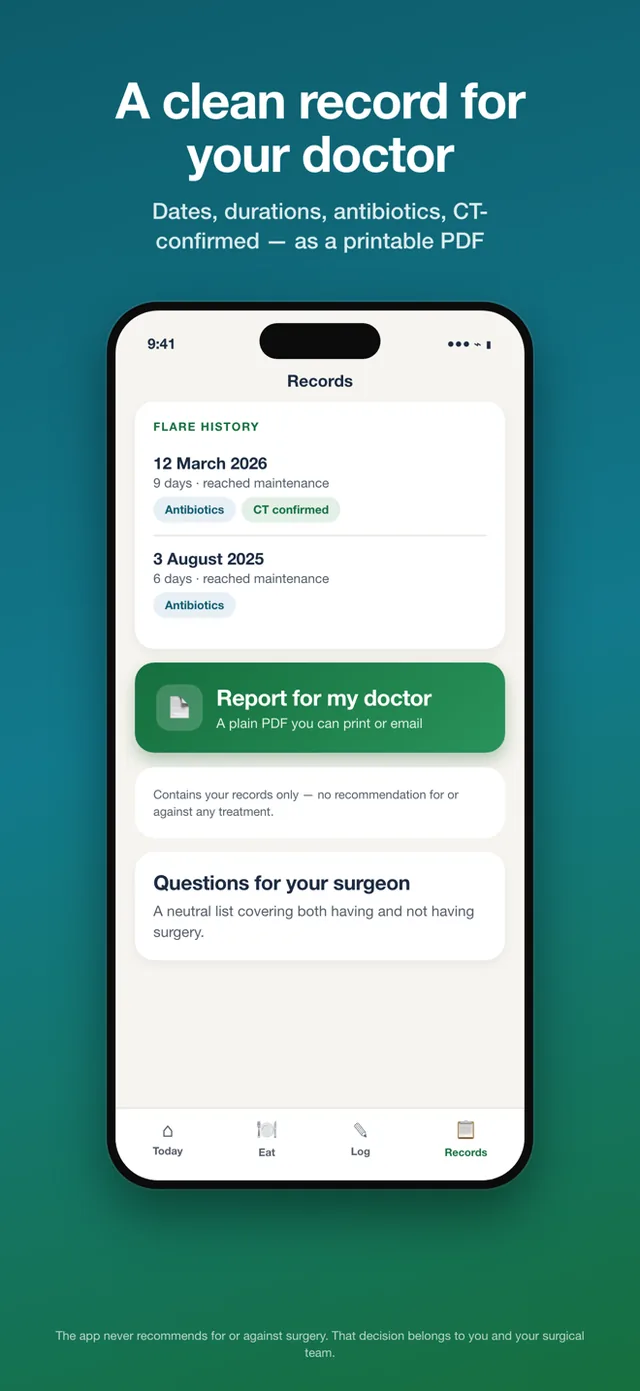
Both trials, and the guideline, rest on imaging. A CT is what separates uncomplicated disease from an abscess sitting quietly behind the same symptoms, and it is also what confirms this is diverticulitis at all rather than one of the conditions that mimic it. That is the practical reason a clinician may be more cautious with you than a headline suggests: without a scan, uncomplicated is an assumption, not a finding.
What being managed without antibiotics actually looks like
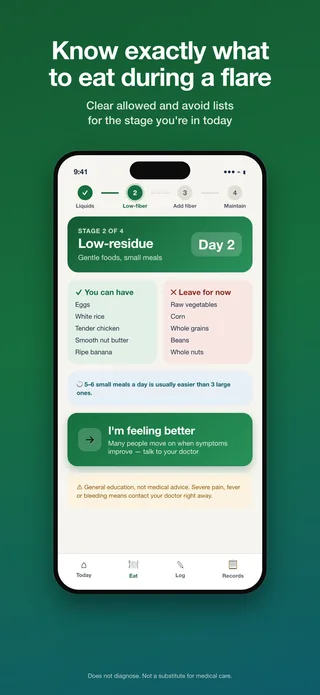
It is not doing nothing, which is the most common misunderstanding. It is a plan with a check-in built into it: symptom control, fluids, a diet that steps down and then back up, a clear description of what should be improving and by when, and an agreed route back if it is not. The usual expectation is improvement within two to three days, and that number is the safety net rather than a guideline.
The diet side is unchanged either way, and is laid out in what to eat during a diverticulitis flare, with the timeline to expect in how long a flare lasts.
If you were prescribed antibiotics, take them
This needs saying plainly. A guideline about which patients can be started without antibiotics is not permission to abandon a course that has been started, and stopping part way through is the one option nobody recommends. If you would rather not be on them, that is a conversation with the person who prescribed them, ideally before day one and not on day three.
What to watch for at home
Contact your doctor or your local emergency number if pain becomes severe or spreads, a fever develops, there is rectal bleeding, vomiting is persistent or you cannot keep liquids down. Short of that, the thing to watch is direction of travel: a flare that has not begun to improve after two or three days is a reason to be reassessed, whether or not antibiotics were part of the plan.
Why your own record shapes the next conversation
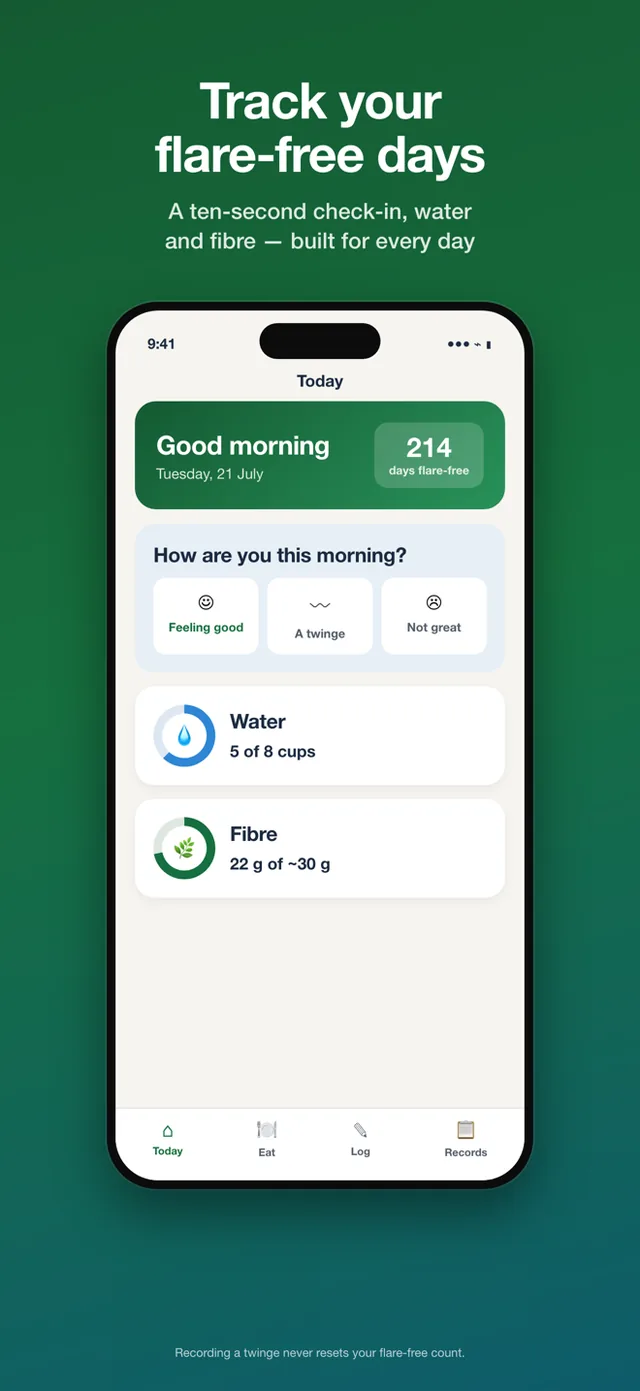
This decision is made on history as much as on today. How many episodes you have had, how far apart, which were confirmed on a scan, which needed antibiotics and how each one behaved is the ground on which someone decides whether to watch or to treat, and later whether to discuss surgery at all. A year later almost nobody can answer those questions accurately from memory, which is a poor reason for a cautious decision to be made on your behalf.
Frequently asked questions
Can you have a diverticulitis flare without an infection? +
To a degree, yes. Diverticulitis is inflammation of the pouches, and how much bacterial infection accompanies it varies from person to person. That is part of why guidance now supports using antibiotics selectively in uncomplicated cases rather than automatically, and why a normal temperature with only mildly abnormal blood tests can still be a real flare.
Do you always need antibiotics for diverticulitis? +
No. The American College of Physicians guideline of 2022 suggests that select patients with acute uncomplicated left-sided diverticulitis can initially be managed without antibiotics, as a conditional recommendation on low-certainty evidence. It applies to a selected group assessed by a clinician, usually with imaging, and not to complicated disease or to anyone immunosuppressed, frail, pregnant or systemically unwell.
Can diverticulitis clear up without antibiotics? +
In the trials behind the current guidance, people with CT-confirmed uncomplicated diverticulitis who were not given antibiotics recovered at broadly similar rates to those who were, with no significant difference in complications and the same median hospital stay of three days. Whether that applies to your flare depends on an assessment you cannot do yourself.
Is it safe to skip the antibiotics I was prescribed? +
No. Stopping or skipping a prescribed course is not what the guidance describes, and it is the one approach nobody recommends. The decision to start without antibiotics is made at the beginning, by the clinician assessing you. If you would rather avoid them, raise it with that clinician rather than acting on it alone.
Why did my doctor prescribe antibiotics if guidelines say they are optional? +
Because the recommendation is conditional and applies to select patients. Fever, a high white cell count, a sharply raised CRP, other illness, a weakened immune system, an unclear diagnosis or no recent imaging all reasonably tip the decision toward treating. Reasonable clinicians also differ where the evidence is low certainty.
How do I know if my diverticulitis is complicated or uncomplicated? +
By assessment, usually a CT scan, which is what distinguishes uncomplicated inflammation from an abscess, perforation, obstruction or fistula. Symptoms alone cannot reliably separate them, which is why the guideline suggests imaging where the diagnosis is uncertain and why trials of skipping antibiotics only enrolled people whose scan had confirmed uncomplicated disease.
Does skipping antibiotics make another flare more likely? +
In the AVOD trial, 16 per cent of both groups were readmitted with a recurrence within a year, so no difference was found there. Longer follow-up of both trials found no significant difference in recurrent or complicated disease either, although both showed a trend toward more bowel resections in the groups managed by observation, which is a reason for the recommendation to remain a cautious one.
This article is general information from Velora Health, not medical advice. It cannot tell you whether you are having a flare and it does not replace medical care. If you have severe or worsening pain, a fever, rectal bleeding, persistent vomiting, or you cannot keep liquids down, contact your doctor or your local emergency number now.