Diverticulosis vs diverticulitis, and why the diet advice points in opposite directions
Two words, four letters apart, and the difference decides what you should be eating this week. Most people meet the first one on a colonoscopy report, with no symptoms and no explanation, and go home to search for a diet plan that turns out to belong to the other one.
Diverticulosis is the presence of small pouches in the wall of the colon. It is common with age, usually causes nothing at all, and is often found by accident. Diverticulitis is what happens when one of those pouches becomes inflamed or infected: pain, most often in the lower left abdomen, frequently with fever. Most people with diverticulosis never develop diverticulitis. The advice reverses between them: generally more fibre for diverticulosis, temporarily less during an acute flare.
The two words, taken apart
Diverticula are the pouches themselves. The ending -osis describes a state, so diverticulosis simply means those pouches exist. The ending -itis means inflammation, so diverticulitis means at least one of them has become inflamed. Diverticular disease is the umbrella term you will also see, used loosely for anything in this family.
So one is a description of your anatomy and the other is something that is happening to you. That is the whole distinction, and almost every confusion downstream comes from treating them as two grades of the same illness.
Side by side
| Diverticulosis | Diverticulitis | |
|---|---|---|
| What it is | Pouches present in the colon wall | One or more pouches inflamed or infected |
| How it feels | Usually nothing at all | Pain, often lower left, frequently with fever |
| How it is found | Usually by accident, on a colonoscopy or a scan | From symptoms, often confirmed on a CT scan |
| How common | Very common, and rises steeply with age | A minority of people who have diverticulosis |
| Fibre advice | Generally more, introduced gradually | Temporarily less during the acute phase |
| Treated as | A finding to live with | An episode to treat |
How common each one is
Diverticulosis becomes ordinary with age. Commonly cited estimates put it in the majority of people over sixty in Western countries, which is why finding it on a scan says less about you than it feels like it does.
What proportion go on to have diverticulitis is genuinely disputed. Older textbook figures suggested up to a quarter; more recent long-term work puts it far lower, in the region of one in twenty-five. The range is wide because the studies count different populations over different periods. What both ends agree on is that most people with diverticulosis never get diverticulitis, and that no estimate is a prediction about you.
Why the diet advice reverses
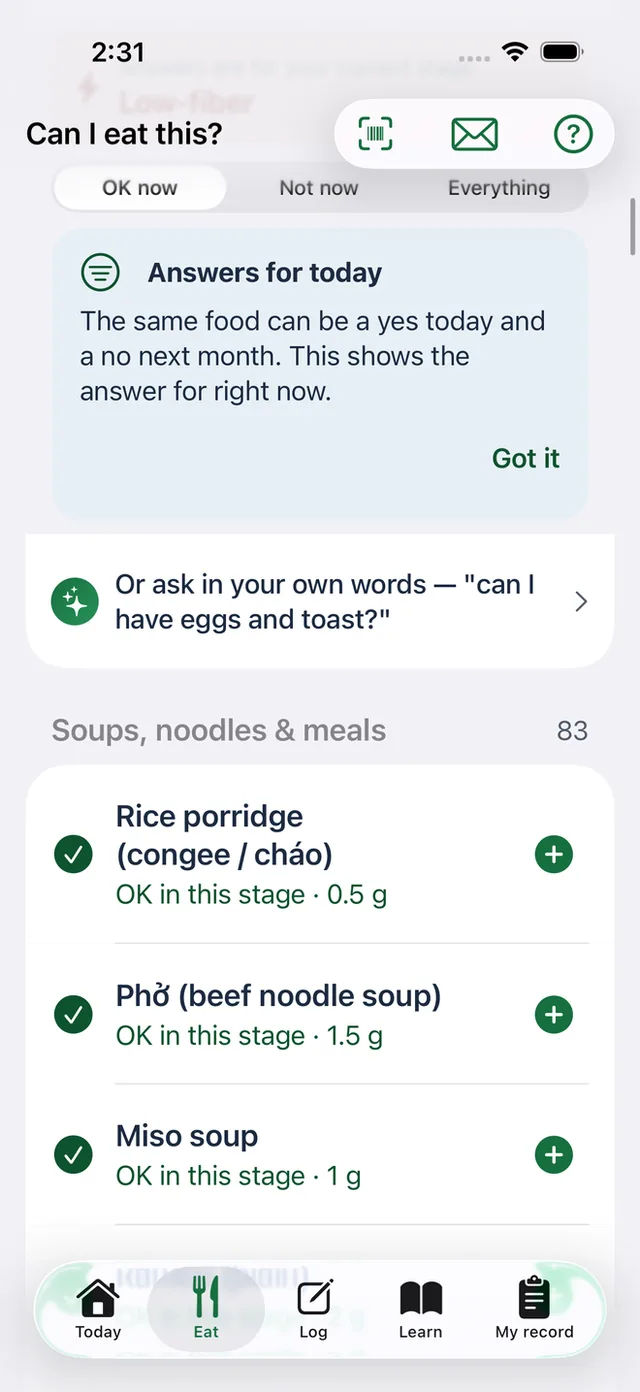
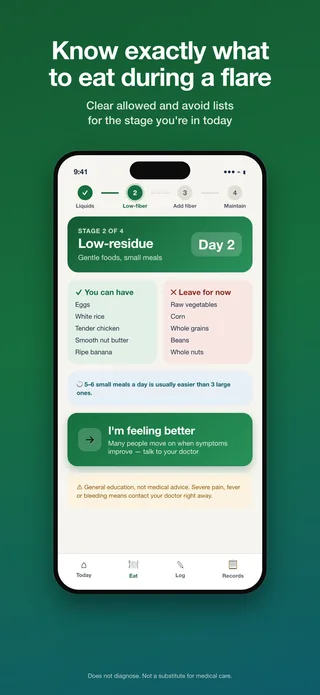
This is the part that makes people think one source must be wrong. Between flares, a higher-fibre diet is the usual long-term recommendation. During an acute flare, fibre is temporarily reduced so that less passes through the inflamed segment while it settles.
Both are correct, for different moments. A food list that does not say which situation it is for will therefore be wrong about half the time you read it, which is exactly how someone with diverticulosis ends up on a clear liquid diet they never needed. The staged version is set out in what to eat during a diverticulitis flare.
You were told you have diverticulosis. Now what.
- It is a finding, not an illness you are now living with. If you have no symptoms, you are not in a flare and the flare diet is not for you
- Fibre goes up gradually, with water. A sudden jump causes gas and cramping that is unpleasant and easy to misread
- Learn the red flags so that if an episode ever happens you recognise it early, which is the single thing that most shortens a flare
- The nuts and seeds question has moved on. It is covered in can you eat nuts, seeds and popcorn
- Ask your own doctor what applies to your case, particularly if the report mentioned anything beyond the pouches themselves
The other names you will run into
Diverticular disease is the general term. Symptomatic uncomplicated diverticular disease describes ongoing symptoms without an acute attack, which is a real and frustrating middle ground. Complicated diverticulitis means an episode with something extra such as an abscess, a perforation or a fistula, and is a different clinical situation from the uncomplicated kind managed at home.
The red flags do not change
Whichever word is on your report, severe or worsening abdominal pain, fever, rectal bleeding, persistent vomiting or being unable to keep liquids down need medical attention now, not a diet adjustment. Diverticulosis being harmless most of the time is not a reason to sit on symptoms.
What is actually worth recording
If you have diverticulosis and no symptoms, very little: know the red flags and get on with your life. If you have had an episode, the useful record is short and specific. When it started, how long it lasted, whether antibiotics were involved, whether a scan confirmed it. That is the history that matters if it ever happens again, and it is the one nobody can reconstruct a year later.
Frequently asked questions
What is the difference between diverticulosis and diverticulitis? +
Diverticulosis is the presence of small pouches in the colon wall, which is common with age and usually causes no symptoms. Diverticulitis is when one or more of those pouches becomes inflamed or infected, causing pain and often fever. One is a finding; the other is an episode that needs treating.
Can diverticulosis turn into diverticulitis? +
It can, but for most people it does not. Estimates of how many go on to have an episode vary widely, from older figures of up to a quarter down to around one in twenty-five in more recent long-term work. Most people with diverticulosis never have a flare.
Do I need a special diet for diverticulosis? +
Generally the advice is a higher-fibre diet introduced gradually, with plenty of fluid, which is the opposite of the temporary low-fibre approach used during an acute flare. If you have no symptoms, the flare diet is not for you. Ask your own doctor what applies to your case.
Does diverticulosis cause pain? +
Usually not. Ongoing symptoms without an acute attack are described as symptomatic uncomplicated diverticular disease and are worth discussing with a doctor, partly because other conditions can produce a similar picture.
Is diverticulosis serious? +
On its own it is a common age-related finding rather than a disease to treat. What matters is recognising an acute episode early if one ever happens, and not ignoring severe pain, fever or rectal bleeding.
This article is general information from Velora Health, not medical advice. It cannot tell you whether you are having a flare and it does not replace medical care. If you have severe or worsening pain, a fever, rectal bleeding, persistent vomiting, or you cannot keep liquids down, contact your doctor or your local emergency number now.