Can you eat nuts, seeds and popcorn with diverticulitis?
Almost everyone diagnosed before the last decade or so was handed the same instruction: no nuts, no seeds, no popcorn, no corn, from now on. It was confident, it was memorable, and it turned out to rest on a theory nobody had tested.
For most people a lifelong ban is not supported. The advice came from a plausible idea, that small fragments lodge in a pouch and start an attack, which was never demonstrated. Large prospective research following tens of thousands of people over many years found no increased risk of diverticulitis from nuts, corn or popcorn, and for some of them found the association ran the other way. These foods are usually excluded only during the temporary low-residue stage of an acute flare, and for a different reason. If your own clinician has advised otherwise for your case, follow them.
Where the advice came from
The reasoning was mechanical and easy to picture. Diverticula are small pouches. Nuts, seeds and popcorn hulls are small hard fragments. A fragment could lodge in a pouch, irritate it and cause an attack. It sounds sensible, it is easy to explain in a two-minute appointment, and it went into patient leaflets on that basis.
What it never had was evidence. The idea was never shown to happen, and it was repeated for decades because it was memorable rather than because it had been checked. That is worth knowing, because the confidence with which people were told this is doing a lot of work in how hard it is to let go of.
What the research actually found
The question was eventually examined properly in a large prospective cohort: tens of thousands of participants, diet recorded as they went rather than remembered afterwards, and diverticulitis events followed over many years. It found no increased risk associated with eating nuts, corn or popcorn. For nuts and popcorn the association pointed mildly in the protective direction.
One study in one population is not the last word on anything, and it is fair to say so. But a large prospective study finding nothing is far stronger evidence than a mechanism with no study behind it at all, and guidance from major medical centres has moved accordingly. The permanent ban is no longer standard advice.
Why they are still off the list during a flare
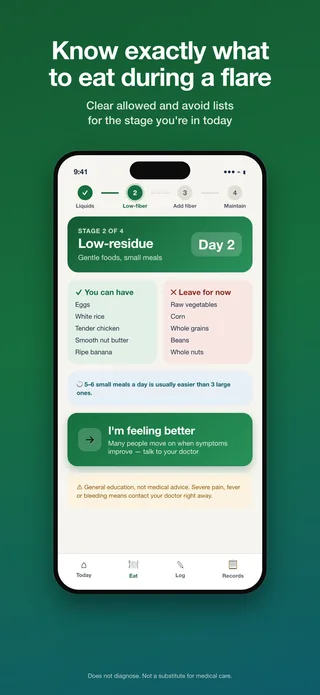
This is where people get whiplash, because during an acute flare you will still be told to avoid them. The reason is different. In the low-residue stage the aim is to reduce what passes through the inflamed segment, so everything high in residue comes out for a while: wholegrains, raw vegetables, skins, pulses, and yes, nuts, seeds and popcorn. They are not being singled out. They are on a list they share with brown rice.
| Stage | Nuts, seeds, popcorn, corn | Why |
|---|---|---|
| Clear liquid stage | Out | Nothing solid at this point |
| Low-residue stage | Out | Everything high in residue is out for now |
| Reintroduction | Back gradually, like any other fibre | The pace matters more than which food |
| Between flares | Generally fine for most people | No good evidence of harm, and fibre is the long-term goal |
So the honest answer to can I eat popcorn is another question: when. During a flare, no, along with most other things. Between flares, for most people, yes. The stage-by-stage version is in what to eat during a diverticulitis flare.
If your doctor still says avoid them
Then follow your doctor, and ask why. There are specific situations where the answer is genuinely still no for you: a narrowed segment of bowel, a recent complication, a procedure coming up, or something else in your history. Those are real reasons and they beat any general article.
What is worth revisiting is advice that arrived on a leaflet years ago and has never been looked at since. Raising it is not arguing with your doctor. It is asking whether a rule you have followed for a decade still applies.
The seeds people usually mean
Strawberry and raspberry seeds, tomato and cucumber seeds, sesame and poppy seeds on bread. These come up constantly and the answer is the same: no evidence supports avoiding them permanently, and they are excluded only while you are in the low-residue phase. A diet built around avoiding every visible seed is a lot of restriction to carry for a theory.
How to settle it for yourself
- Wait until you are well between flares, not mid-recovery
- Reintroduce one of them, in a normal portion, at a meal where nothing else is new
- Note how you felt over the next day or two, including when nothing happened at all
- Repeat it once before concluding anything, because a single bad day usually has another cause
- Keep the running record, because your own evidence is the only version of this list that is actually about you
Frequently asked questions
Can you eat nuts and seeds with diverticulitis? +
Between flares, for most people, yes. The old advice to avoid them for life came from a theory that was never demonstrated, and large prospective research found no increased risk from nuts, corn or popcorn. During an acute flare they are excluded along with all other high-residue foods, temporarily. Follow your own clinician if they have advised otherwise for your case.
Can I eat popcorn if I have diverticulosis? +
Generally yes. Diverticulosis means the pouches are present, which for most people causes no symptoms and does not call for the acute flare diet. Popcorn was part of the old blanket ban that current guidance no longer supports.
Why was I told to avoid nuts and seeds? +
Because of a long-standing idea that fragments could lodge in a diverticulum and trigger an attack. It was plausible and widely repeated, but it was never shown to happen, and the research that eventually examined it found no increased risk.
Are strawberry and tomato seeds a problem? +
There is no evidence that they are, outside the temporary low-residue stage of an acute flare when high-residue foods generally come out. Avoiding every visible seed permanently is a large restriction resting on a theory rather than a finding.
When can I eat nuts again after a flare? +
As fibre comes back generally, once symptoms have settled and you are advancing your diet as tolerated. Add them gradually rather than all at once, since a fast return of fibre commonly causes gas and cramping that can be mistaken for the flare returning.
This article is general information from Velora Health, not medical advice. It cannot tell you whether you are having a flare and it does not replace medical care. If you have severe or worsening pain, a fever, rectal bleeding, persistent vomiting, or you cannot keep liquids down, contact your doctor or your local emergency number now.