Why rosacea flares up, and why the timing is a clue
Rosacea flares feel random until you notice they are not. They cluster at particular times of day, particular seasons, and for a surprising number of people, on one particular side of the face. Each of those patterns has a plausible explanation, and each one points at something you can test.
Rosacea flushing is a blood vessel response, so anything that widens facial blood vessels can set it off: heat, sun, alcohol, hot drinks, spicy food, exercise, stress and sudden temperature change. Flares often cluster in the evening because the day's triggers accumulate and because alcohol and hot food arrive at dinner. Winter flares are usually the cold-outside to heated-inside swing rather than the cold itself. Triggers are individual, which is why a personal record beats any list.
Why the evening is the worst time for so many people
Three things stack up by the end of the day. Sun exposure earlier on can show up hours later, since UV damage to facial vessels does not announce itself immediately. Alcohol and hot food usually arrive at dinner rather than breakfast. And skin temperature rises indoors in the evening, especially after a hot shower or with heating on.
This is worth knowing because the obvious conclusion (something I eat at dinner) is often wrong. The trigger may have been at midday. Logging the time of the flare AND what happened several hours earlier is what separates those two explanations.
Why winter, when heat is supposed to be the trigger
It is not really the cold. It is the swing: cold wind outside constricts the vessels, then a heated room dilates them again, and that repeated cycle is what irritates rosacea-prone skin. Add low humidity from indoor heating, which weakens the skin barrier, and winter becomes a bad season for a condition people assume is a summer problem.
The practical version: care about the transition, not the temperature. A scarf over the lower face outside, and not going straight to a hot shower or a fire when you come in.
Why one side of the face is worse
This one surprises people, and it usually has a mundane explanation. The most common is driving: in most countries the driver's side takes far more sun through the side window, and standard car glass blocks less UVA than a windscreen does. Sleeping position is the other frequent one, if you consistently sleep on the same cheek.
Less commonly it reflects where you apply products, or which side you rest your hand or phone against. If one side is consistently worse, the question to ask is what that side gets more of.
Before a period
Premenstrual flares are commonly reported, and are consistent with hormonal effects on blood vessels and skin inflammation. If your flares are cyclical, that is genuinely useful to know, because it changes what you conclude from a food you happened to eat that week.
Alcohol and dairy, separately
Alcohol is one of the most consistently reported rosacea triggers, and red wine most of all. The mechanism is straightforward vasodilation, so the effect tends to be fast and obvious rather than delayed.
Dairy is a much weaker case. It appears constantly in online rosacea advice, but the evidence linking dairy to rosacea is thin, and some people find dairy has no effect at all. That does not mean your own reaction is imaginary. It means dairy is worth testing individually rather than eliminating on the strength of a blog post, particularly since cutting a whole food group has its own costs.
How to test a suspected trigger properly
- Log flushing daily for two weeks first, changing nothing, so you know your baseline
- Remove or add one suspected trigger, not several
- Keep it changed for at least two weeks, since single days prove nothing with a condition this variable
- Log the time of each flare, not just the day
- Compare the two periods before concluding
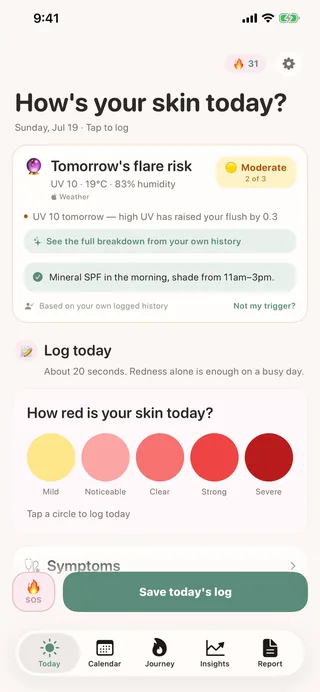
Weather and UV are the two triggers people never log, because you have to look them up. Automating that is most of the value: many people find their unexplained flares line up neatly with high-UV days, even ones spent mostly indoors. Flarewell records your flush with the day's weather and UV attached, which is what makes that pattern visible. The broader trigger-finding method is in what triggers rosacea, and how to find yours.
When to see a dermatologist rather than experiment
Eye symptoms alongside rosacea, such as persistent grittiness, redness or a feeling of something in the eye, can indicate ocular rosacea and deserve assessment rather than skincare adjustments. So does skin thickening around the nose, and any flare that is not responding to what previously worked.
Frequently asked questions
Why does rosacea flare up in the evening? +
The day's triggers accumulate: earlier sun exposure can show up hours later, alcohol and hot food usually arrive at dinner, and skin temperature rises indoors in the evening. The cause is often several hours before the flare, not at the moment it appears.
Why does rosacea flare up in winter? +
Usually the swing between cold outside and heated rooms, rather than cold itself, along with low indoor humidity weakening the skin barrier. Managing the transition matters more than the temperature.
Why is my rosacea worse on one side of my face? +
The most common explanation is asymmetric sun exposure, classically the driver's side through a car window, since side glass blocks less UVA than a windscreen. Sleeping consistently on one cheek is the other frequent cause.
Is dairy bad for rosacea? +
The evidence linking dairy to rosacea is thin, unlike alcohol which is one of the most consistently reported triggers. Some individuals do react. That makes dairy worth testing on its own rather than eliminating on general advice.
Does alcohol cause rosacea? +
Alcohol does not cause rosacea, but it is among the most commonly reported triggers for flushing in people who have it, with red wine reported most often. The effect is usually rapid because it works by dilating blood vessels.
Why does my rosacea flare before my period? +
Premenstrual flares are commonly reported and are consistent with hormonal effects on blood vessels and skin inflammation. Tracking your cycle alongside flares tells you whether that pattern is yours.
This article is general wellness information from Velora Health, not medical advice, diagnosis or treatment. Always consult a qualified healthcare professional about your symptoms and before changing anything about your care.