Does seborrheic dermatitis spread, and does it cause hair loss?
Two questions come up more than any others, and both have reassuring answers that are hard to find under the product pages. No, it is not contagious. And the hair loss, when it happens, is usually not permanent.
Seborrheic dermatitis is not contagious. You cannot catch it or pass it on, because it is a reaction to a yeast that lives on everyone's skin rather than an infection you acquire. It commonly appears in several oily areas at once, which looks like spreading but is the same condition showing up wherever the conditions suit it. Hair loss can occur, mainly from inflammation and scratching, and hair usually regrows once the inflammation is controlled.
Why it is not contagious, despite looking like it
The condition involves Malassezia, a yeast that is a normal resident of human skin, present on nearly everyone. Seborrheic dermatitis is not caused by acquiring it, but by an inflammatory reaction to it in people whose skin responds that way, in areas where sebum gives it something to feed on.
So there is nothing to catch. Sharing a pillow, a hairbrush or a towel does not transmit it, and you are not putting anyone at risk. This is worth stating plainly because a visible scaly rash on the face and scalp carries an assumption of contagion that people around you may hold and you may have absorbed.
Why it appears in several places at once
It shows up where sebaceous glands are dense: the scalp, the eyebrows and between them, the creases beside the nose, behind and in the ears, the beard area, the mid-chest and sometimes the upper back. Someone with scalp involvement developing eyebrow and nasal crease involvement has not spread it from one to the other; those areas were always candidates and the flare has reached them.
The practical consequence is that treating only the scalp while the face flares is a common and avoidable mistake, and that different areas often need different formulations, since what is appropriate for the scalp may be too harsh for facial skin.
The hair loss question
Hair loss can happen, and the usual mechanisms are inflammation of the scalp disrupting the growth cycle, and physical damage from persistent scratching. It is generally not scarring, which is the important word: because the follicle is not destroyed, hair typically regrows once inflammation is brought under control.
Two caveats worth knowing. Regrowth takes months rather than weeks, because hair growth is slow, so patience is required after the scalp itself looks better. And if hair loss continues after the seborrheic dermatitis is controlled, or if you see smooth shiny patches with no visible follicles, that pattern is different and needs a dermatologist, since another cause may be present alongside.
What actually drives flares
- Cold, dry weather. Most people report winter as the worst season
- Stress and poor sleep, reported consistently
- Oily skin and sebum production, which is why it starts around puberty for many
- Stopping treatment once it looks better, which is the most common reason it returns
- Some products, particularly heavy oils and certain ingredients that feed the yeast
That last one is why ingredient checking matters more here than in most skin conditions: a product marketed as gentle and natural can be exactly the wrong thing if it contains oils that Malassezia thrives on.
Why treatment fails even when it works
The pattern is almost universal: antifungal shampoo is used until things clear, then stopped, then the flare returns in a few weeks and the shampoo is blamed. Seborrheic dermatitis is managed rather than cured, and most regimens involve continuing at a reduced frequency after clearing rather than stopping. The other frequent error is not leaving medicated shampoo on long enough for it to do anything, since the contact time is what matters, not the wash.
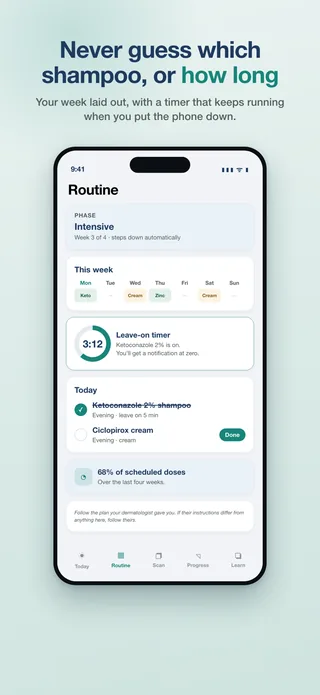
Both of those are timing problems rather than product problems, which is exactly what a routine tracker is good at: a rotation across the week, a leave-on timer that keeps running, and a record showing what your skin did the last time you tapered. That is what SebDerm does, along with an ingredient scanner. The routine itself is in the antifungal shampoo routine.
When to see a dermatologist
If it is not responding to over-the-counter antifungals after several weeks, if it is severe or widespread, if hair loss continues once the scalp is calm, or if there is any doubt about the diagnosis, since psoriasis and other conditions can look similar. Facial involvement being treated with steroid creams long-term also warrants review, since prolonged use on facial skin has its own problems.
Frequently asked questions
Is seborrheic dermatitis contagious? +
No. It is an inflammatory reaction to a yeast that already lives on nearly everyone's skin, not an infection you catch or pass on. Sharing towels, pillows or hairbrushes does not transmit it.
Can seborrheic dermatitis spread from scalp to face? +
It commonly affects several oily areas at once, including the scalp, eyebrows, creases beside the nose, ears and chest. That is the same condition appearing where conditions suit it rather than spreading from one site to another.
Does seborrheic dermatitis cause hair loss? +
It can, mainly through scalp inflammation and scratching. It is generally not scarring, so hair usually regrows once inflammation is controlled, though regrowth takes months. Hair loss continuing after the scalp is calm should be assessed.
Does the hair grow back? +
Usually yes, because the follicle is typically not destroyed. Expect months rather than weeks, since hair growth is slow. Smooth shiny patches without visible follicles are a different pattern and need a dermatologist.
Why does it keep coming back? +
Because it is managed rather than cured, and most people stop treatment once the skin clears. Regimens generally involve continuing at a reduced frequency. Not leaving medicated shampoo on long enough is the other common reason it seems ineffective.
What makes seborrheic dermatitis worse? +
Cold dry weather, stress and poor sleep, higher sebum production, stopping treatment after clearing, and certain products including heavy oils that the yeast can feed on.
This article is general wellness information from Velora Health, not medical advice, diagnosis or treatment. Always consult a qualified healthcare professional about your symptoms and before changing anything about your care.