Building a seborrheic dermatitis shampoo routine you can keep
Most people with seborrheic dermatitis are handed two or three products and a sentence: use these a few times a week. What nobody explains is how they fit together, how long each one has to stay on, or why the moisturiser you bought to calm the flaking made it worse. Here is how the pieces actually work.
Why rotation is the usual approach
Seborrheic dermatitis is associated with Malassezia, a yeast that lives on everyone's skin and feeds on the oils in it. Treatment usually aims at two things at once: reducing that yeast, and calming the inflammation it provokes. Different active ingredients do different parts of that job, which is why clinicians often prescribe a rotation rather than one bottle.
A typical set includes an azole antifungal such as ketoconazole, plus something like zinc pyrithione or selenium sulfide, and sometimes a short course of a topical steroid or a calcineurin inhibitor for the inflamed phase. Your specific combination is your clinician's call, and it is the one to follow.
Leave-on time is the part most people get wrong
A medicated shampoo is a topical medication that happens to be in a shampoo bottle. Rinsing it straight out is close to not using it. Most products specify a contact time, often several minutes, and in a hot shower with the water running that interval feels far longer than it is.
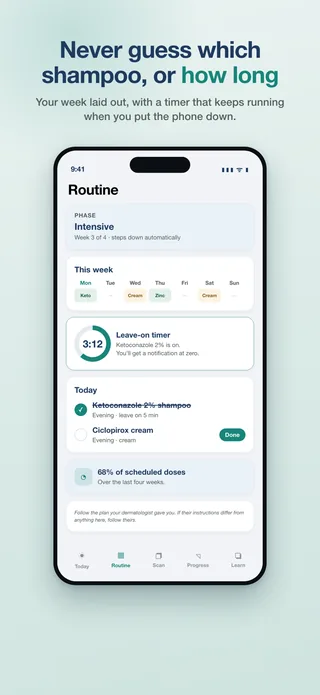
Two things make this survivable. Apply the medicated product first, then wash the rest of you while it sits. And use a timer that keeps running when you put the phone down, rather than counting in your head, because everyone under-counts.
The intensive phase is meant to end
Rotations usually start intensive, often several times a week for a few weeks, then step down to a maintenance frequency that holds the improvement. The step-down matters: staying on an intensive routine indefinitely is unnecessary for most people, and with steroids specifically it carries risks the intensive phase was never meant to run long enough to create.
If you have been on the same strong routine for months because nobody told you when to stop, that is a good question for your next appointment rather than a decision to make alone.
Track topical steroid days, especially on the face
Topical steroids on facial skin are intended for short courses. The problem is not usually a single course, it is that several separate courses across a year blur together and nobody is counting. Facial skin is thinner and more vulnerable to thinning, visible vessels and rebound flaring when a strong steroid is used for too long.
Keeping a simple count of the days you actually applied one gives you a number to bring to your clinician. That number is almost always more useful than trying to remember.
What feeds Malassezia in ordinary products
This is the part that catches people out. Malassezia depends on lipids, so several ingredient families common in gentle, well-reviewed skincare can feed it:
- Fatty acids and their esters, which appear under many names on a label
- Plant oils, including several marketed as soothing
- Polysorbates and some emulsifiers
- Fermented ingredients, common in recent skincare trends
Note the limits of this. The evidence is largely from laboratory work on which lipids the yeast can grow on, not from trials of finished cosmetic products, and concentration and formulation matter. Treat a flag as a reason to patch test and watch your own skin, not as proof a product will cause a flare. Mineral oil, squalane and many silicones are commonly considered lower risk, and plenty of people tolerate ingredients on the list.
Give it more time than feels reasonable
Skin changes slowly and memory is generous, so six weeks of effort can genuinely feel like nothing happened. A weekly score of your own symptoms, plus photographs taken at the same angle and lighting, is the only fair way to answer whether a routine is working. Change one variable at a time, then wait long enough to judge it.
When to stop self-managing
See a doctor if it is spreading, if the skin is oozing, crusting or painful, if you have a fever, if it appeared suddenly and severely, or if a routine that used to work has stopped. Seborrheic dermatitis also looks like several other conditions, including psoriasis and tinea, and those are treated differently. Getting the label right is worth an appointment.
Frequently asked questions
How long should I leave medicated shampoo on? +
Follow the contact time on your product and from your clinician; many specify several minutes. Applying it first and washing the rest of you while it sits is the usual way to make that practical. Rinsing it straight off does very little.
How often should I use antifungal shampoo? +
Rotations commonly start more frequently for a few weeks, then step down to a maintenance frequency. The right numbers depend on the product, your hair and your skin, so use the schedule your clinician gave you rather than a schedule from the internet.
Which ingredients feed Malassezia? +
Lipid ingredient families are the usual suspects: fatty acids and their esters, many plant oils, polysorbates and fermented ingredients. The evidence is mostly laboratory work on yeast growth rather than trials of finished products, so use it to guide patch testing rather than as a verdict.
Is seborrheic dermatitis the same as dandruff? +
They sit on the same spectrum. Dandruff is generally the milder scalp form, while seborrheic dermatitis can be more inflamed and affects other oily areas such as the face, ears and chest. A clinician should confirm which you have, since psoriasis and fungal infections can look similar.
Can seborrheic dermatitis be cured? +
It is generally a long-term condition that is managed rather than cured, with periods of improvement and flares. The aim of a routine is to keep it quiet with the least treatment that works, which is why the step-down to maintenance matters.
This article is general information from Velora Health, not medical advice. It does not diagnose, treat, cure or prevent any condition. Seborrheic dermatitis is managed differently from person to person, so follow the plan your own clinician gave you, and see a doctor if symptoms worsen, spread, or show signs of infection such as oozing, pus, pain or fever.