How PCOS is actually diagnosed, and what to bring to the appointment
Searching your symptoms for PCOS returns quizzes, type-yourself frameworks and a lot of confidence. The actual diagnostic process is narrower than any of that, and knowing how it works is the difference between an appointment that goes somewhere and one that does not.
PCOS is diagnosed by a clinician, most commonly using criteria that require at least two of three features: irregular or absent ovulation, signs of raised androgens either on examination or in bloodwork, and polycystic-appearing ovaries on ultrasound. Crucially, other conditions must be excluded first, because several can look similar. Polycystic ovaries on a scan alone are not PCOS, and no online quiz can make the diagnosis.
The three features, and why two is the threshold
| Feature | What it means in practice |
|---|---|
| Irregular or absent ovulation | Cycles that are consistently long, unpredictable or absent. Often the first thing noticed |
| Raised androgens | Either measured in blood, or visible as excess hair growth, persistent acne or scalp hair thinning |
| Polycystic ovaries on ultrasound | A characteristic appearance and follicle count. Common, and on its own not diagnostic |
Requiring two of three is what stops the diagnosis being made on a scan finding that plenty of people without PCOS also have. It is also why someone can have PCOS with normal-looking ovaries, which surprises people who assume the name describes the requirement.
Why exclusion matters as much as the criteria
Thyroid disorders, raised prolactin, and some adrenal conditions can produce overlapping symptoms, and they are treated completely differently. This is why a doctor orders bloodwork that seems unrelated to your question. A PCOS diagnosis made without those exclusions is not a safe diagnosis, and it is the main reason self-diagnosis from symptoms goes wrong.
About the four types of PCOS
This framing, usually listed as insulin resistant, post-pill, inflammatory and adrenal, appears everywhere online. It is worth being straight about it: it is not a recognised medical classification and you will not find it in the diagnostic criteria your doctor uses. It originates in naturopathic and functional medicine writing.
That does not make every idea inside it useless. Insulin resistance genuinely is common in PCOS and genuinely does affect management. But walking into an appointment saying you have adrenal PCOS is likely to confuse the conversation rather than speed it up, and some of the advice attached to those categories is not supported. The useful version is to describe your symptoms and let the criteria do the work.
What to track before the appointment
- Cycle dates for as many months back as you can reconstruct, then forward. This is the single most useful thing you can bring
- Symptoms with dates: acne, hair growth or loss, weight changes, mood
- Any previous bloodwork or scans, gathered in one place
- Family history of PCOS, type 2 diabetes or thyroid disease
- What you have already tried, including hormonal contraception and when you stopped
Cycle length variability is what an endocrinologist or gynaecologist reads first, and it is exactly the thing memory reconstructs badly. Three or four months of accurate dates changes the appointment, especially printed as a one page PCOS symptom report rather than recalled at the desk.
If you have been dismissed before
It is common, and it is worth preparing for. Bring the data rather than the conclusion: a record of cycle lengths, dated symptoms and what you have tried is much harder to wave away than a description of how you feel. Asking directly which of the diagnostic criteria you meet, and which have been assessed, is a reasonable and specific question.
What happens after a diagnosis
Management is individual and depends on what matters most to you now, whether that is cycle regularity, symptom control, metabolic health or fertility. It usually involves some combination of lifestyle measures and medication. Whichever direction it goes, the tracking that got you diagnosed keeps being useful, because response to a change is measured the same way.
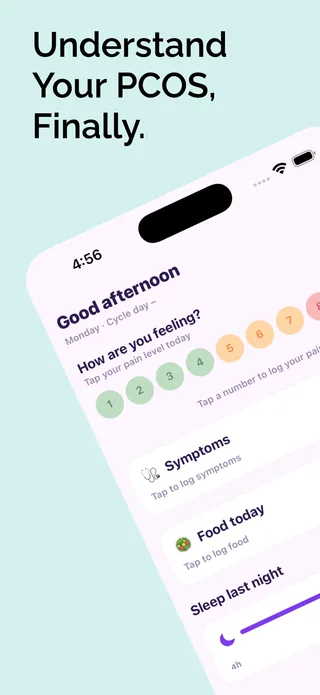
Luna records cycle, symptoms, food and sleep together and finds patterns across them, then exports a clean report. Food triggers specifically are covered in how to find your PCOS food triggers.
Frequently asked questions
How is PCOS diagnosed? +
By a clinician, usually requiring at least two of three features: irregular or absent ovulation, signs of raised androgens on examination or in bloodwork, and polycystic-appearing ovaries on ultrasound, after excluding other conditions that can look similar.
Can I have PCOS without cysts on my ovaries? +
Yes. The criteria require two of three features, so someone can meet them through irregular ovulation and raised androgens with normal-looking ovaries. The name describes an appearance, not a requirement.
Are the 4 types of PCOS real? +
The insulin resistant, post-pill, inflammatory and adrenal framing is not a recognised medical classification and is not part of the diagnostic criteria. It comes from naturopathic writing. Insulin resistance itself is genuinely relevant to PCOS management.
What should I track before a PCOS appointment? +
Cycle dates above all, plus dated symptoms such as acne, hair changes and mood, any previous bloodwork or scans in one place, family history, and what you have already tried. Cycle variability is what a specialist reads first.
Does PCOS go away after menopause? +
Cycle-related features change once periods stop, but PCOS is associated with longer-term metabolic considerations that do not simply end at menopause. It is worth continuing that conversation with a doctor rather than assuming it resolves.
Can an app diagnose PCOS? +
No. Luna records your cycle, symptoms and context and surfaces patterns for you to bring to a clinician. Diagnosis requires examination, bloodwork and exclusion of other conditions.
This article is general wellness information from Velora Health, not medical advice, diagnosis or treatment. Always consult a qualified healthcare professional about your symptoms and before changing anything about your care.