How to turn a song into piano sheet music
You have a song in your head and want to play it on the piano. Sometimes a good arrangement already exists. Often it does not, or the one you find is written for a concert pianist. Here are the three realistic routes from a recording to a sheet you can actually play, and what each is good for.
There are three routes: find an existing arrangement (best for well-known songs, check the difficulty level), transcribe it by ear (slow, but the best training there is), or use an AI transcription app that turns audio into notation in minutes. For songs with vocals and a band, the useful output is a piano arrangement, melody in the right hand and chords in the left, not a note-for-note transcription of every instrument. Whatever route you take, pick a version at the level you can play today.
Route 1: find an existing arrangement
For popular songs, someone has often arranged it already. Licensed digital sheet music shops sell arrangements of current songs at several levels, usually labelled beginner, easy piano, intermediate and original. Community sites host free user-made arrangements, which range from excellent to unplayable. For classical pieces, public domain libraries have scans of most of the standard repertoire.
What to check: the difficulty level and the key. An "original" arrangement of a pop ballad can be much harder than the song sounds, and a version in six flats is a different challenge from one in C. Look at the first page before you commit.
Route 2: work it out by ear
Transcribing by ear is slow, and it is the single best way to train your ear. A practical order:
- Find the key. Hum the note the song feels like it wants to end on, and find it on the piano
- Pick out the melody one phrase at a time, using a slowed-down recording
- Find the bass notes under each chord change, then build chords on them
- Write it down in a notation app, or as melody plus chord symbols, which is how many pianists actually play pop songs
Expect hours for a three-minute song the first few times. It gets much faster.
Route 3: use an AI transcription app
Transcription apps listen to audio and write out the notes. They have improved a lot, and for many people they are now the fastest way to a starting point. What to know before you start:
- Solo piano recordings transcribe best, because every note in the audio belongs on the page
- Songs with vocals and a band need a different approach. A note-for-note transcription of a full mix is unplayable. What you want is an arrangement: the vocal melody in your right hand and the song's chords in your left
- Difficulty matters more than accuracy. A perfect transcription you cannot play is less useful than a simplified version you can. Look for an app that gives easier versions
- Check and correct. Every machine transcription has mistakes. Exporting to MusicXML lets you fix them in a notation app
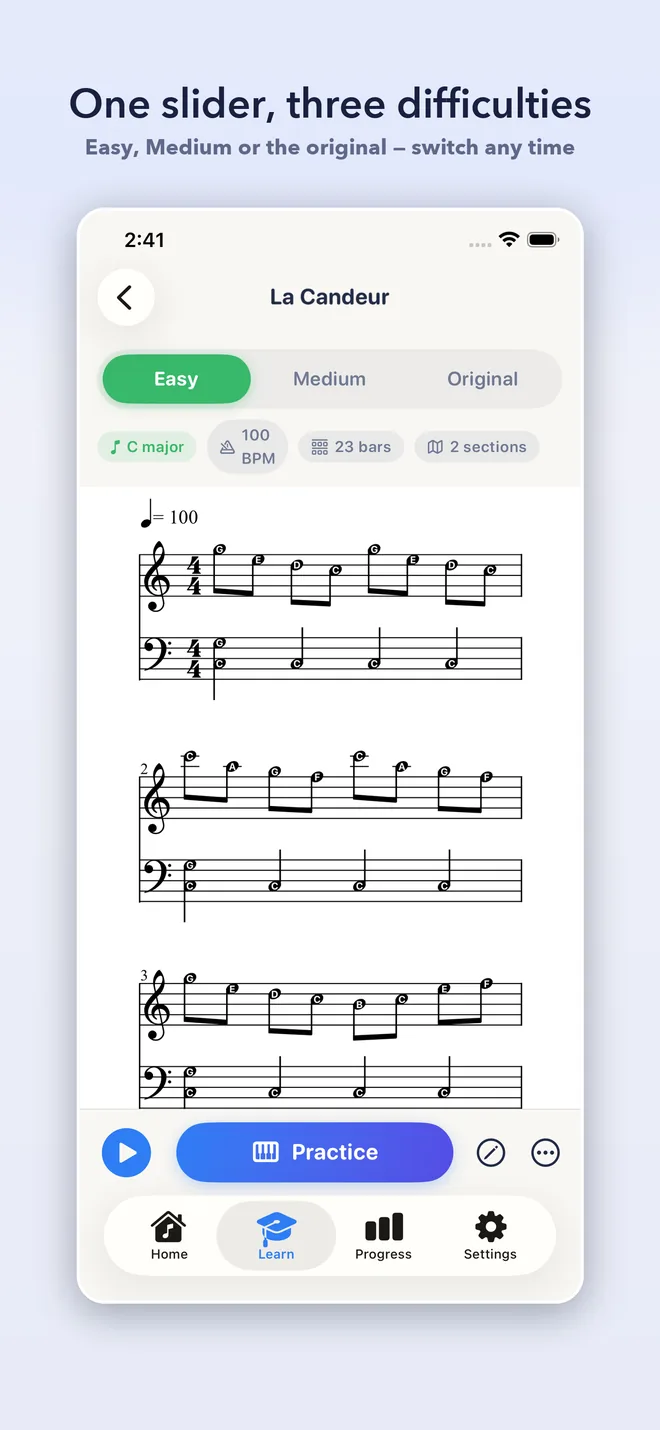
Choosing the right difficulty
| Level | What is on the page | Good for |
|---|---|---|
| Easy | Melody in the right hand, single bass notes in the left | Beginners, or learning a song quickly |
| Medium | Melody plus left-hand chords | Sounding like the record, after a year or so of playing |
| Original | Full arrangement, nothing simplified | Experienced players, or a version to grow into |
A useful habit is to learn the easy version first, then move up a level once it is comfortable. The melody and structure stay the same, so nothing you learned is wasted.
A note on rights
A transcription of a song is a copy of the composition. Making one for your own private practice is generally fine, but sharing or selling an arrangement of a copyrighted song needs a licence. Only transcribe audio you have the right to use, such as music you own or your own recordings.
From sheet to playing it
Getting the notes on the page is half the job. The other half is the practice: hands separately, slowly, then together, then up to speed. How to learn a piano song fast covers a day-by-day plan that works even with fifteen minutes a day.
Frequently asked questions
How do I turn a song into piano sheet music? +
Find an existing arrangement, transcribe it by ear, or use an AI transcription app that converts audio into notation. For songs with vocals and a band, look for a piano arrangement with the melody in the right hand and chords in the left.
Can AI convert a song with vocals into piano sheet music? +
Yes, if it produces an arrangement rather than a note-for-note transcription. The useful result puts the vocal melody in the right hand and the song's chords in the left.
What is the easiest way to get easy piano sheet music for a song? +
Look for an arrangement labelled easy or beginner, or use an app that generates several difficulty levels from the same song, so you can start easy and move up.
Is it legal to transcribe a song for piano? +
Making a transcription for your own private practice is generally fine. Sharing or selling an arrangement of a copyrighted song requires a licence.
How long does it take to transcribe a song by ear? +
For a beginner, often several hours for a three-minute song. It gets much faster with practice, and it is one of the best ways to train your ear.
PianoSheet AI is made by Velora Health. Transcriptions are for private study and practice of music you have the rights to use.