How to get rid of a cold sore fast, and how long each stage lasts
If you are reading this with a cold sore already on your lip, the honest answer comes first: nothing makes a cold sore disappear overnight, whatever the internet promises. What genuinely changes how long it lasts and how bad it gets is when you act. The earlier, the more difference it makes.
There is no way to get rid of a cold sore in 24 hours. Most heal in about 7 to 10 days. What shortens one is starting treatment at the first tingle, before a blister appears: antiviral creams from a pharmacy help modestly, and prescription antiviral tablets taken early can shorten an outbreak further. Once the blister has formed, the aim shifts to comfort, protecting the sore and not spreading it. See a doctor urgently if a sore is near the eye, or if a baby or someone with eczema or a weakened immune system is affected.
The stages of a cold sore, and how long each lasts
| Stage | Typical timing | What is happening |
|---|---|---|
| Tingle | Day 1 | Itching, burning or tingling before anything is visible. The best moment to start treatment |
| Blister | Days 2 to 3 | Small fluid-filled blisters appear, often in a cluster |
| Weeping | Around day 4 | Blisters burst and leave a shallow, painful sore. The most contagious point |
| Crust | Days 5 to 8 | A yellow or brown scab forms and may crack |
| Healing | Days 8 to 10 or so | The scab falls away and the skin settles, sometimes a little pink for a while |
Timings vary between people and between outbreaks, and a first ever outbreak is often longer and more severe than later ones. A cold sore that has not healed after two weeks is worth showing to a doctor.
The only thing that really speeds it up: timing
Antiviral treatment works by slowing the virus while it is multiplying, which happens early. Started at the tingle, it can mean a smaller sore that heals sooner, and sometimes a blister that never fully develops. Started after the blister has burst, it makes much less difference, because most of that work is already done.
That is why people who get cold sores regularly benefit most from recognising their own early signs and having treatment ready before they need it. What those first hours feel like, and why they matter so much, is in the cold sore prodrome.
Treatments that help
- Antiviral creams from a pharmacy, applied from the first tingle and repeated as directed. The benefit is real but modest, often around a day shorter
- Prescription antiviral tablets, which a doctor or pharmacist prescriber may offer, particularly if you get cold sores often or badly. Taken at the first sign, they can shorten an outbreak more than creams
- Cold sore patches, which cover the sore, protect it while it heals, make it less visible and reduce the chance of touching and spreading it
- Pain relief such as paracetamol, if the sore is painful, and a cold compress held gently against it
- Petroleum jelly on the scab, to stop it drying out, cracking and bleeding
What does not help, or makes it worse
- Popping or picking the blister. It spreads the virus, delays healing and raises the risk of infection and scarring
- Toothpaste, alcohol, lemon or salt. Popular, unproven, and likely to irritate broken skin
- Repeatedly touching it, then touching your eyes or other people
Is a cold sore contagious, and for how long?
Yes, from the first tingle until the sore has completely healed, and most of all while the blisters are weeping. During that time avoid kissing and oral sex, do not share cups, cutlery, towels or lip products, and wash your hands after touching the area.
Keep away from newborn babies while you have a cold sore. The virus can be very serious for them, which is why this is the one situation where caution cannot be relaxed.
When to see a doctor
Urgently if a sore is on or near the eye, if a newborn or young baby develops sores, or if someone with eczema develops spreading painful sores on the skin. Also see a doctor if you have a weakened immune system, if a sore is very large or spreading, if it has not healed in two weeks, or if you get cold sores very often, since preventative treatment exists.
Stopping the next one earlier
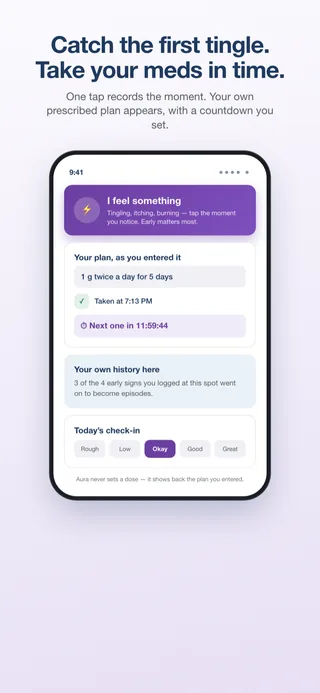
Most people who get cold sores have triggers: sun, a cold, stress, tiredness, sometimes their period. Knowing yours means you can use sunscreen lip balm, keep treatment with you, and act at the tingle rather than the blister. The common triggers are covered in why you keep getting cold sores, and Aura is built to catch the tingle and time the treatment window.
Frequently asked questions
Can you get rid of a cold sore in 24 hours? +
No. There is no treatment that clears a cold sore overnight. Starting antiviral treatment at the first tingle, before a blister forms, is what shortens an outbreak and sometimes stops it developing fully.
How long does a cold sore last? +
Most heal in about 7 to 10 days, passing through tingling, blistering, weeping, crusting and healing. A first outbreak is often longer. See a doctor if one has not healed after two weeks.
How do you make a cold sore go away faster? +
Start an antiviral cream at the first tingle, or ask a doctor or pharmacist about antiviral tablets if you get them often. Do not pick or pop it, protect it with a patch, and keep the scab moist with petroleum jelly so it does not crack.
Should I pop a cold sore? +
No. Popping or picking spreads the virus, delays healing and increases the risk of infection and scarring.
When is a cold sore no longer contagious? +
When it has completely healed and the scab has gone. It is most contagious while the blisters are weeping. Avoid kissing and sharing items until then, and keep away from newborn babies.
What are the stages of a cold sore? +
Tingling on day one, blisters on days two to three, weeping around day four, crusting from about day five to eight, and healing by around day eight to ten, though timings vary.
This article is general information from Velora Health, not medical advice, and it is not a substitute for care from a clinician. It does not tell anyone when or whether to take a medication; only your own prescriber can do that. Speak to a healthcare professional about diagnosis, treatment options and transmission risk.