A safety net for a parent living alone, that isn't a camera
Eight in ten older adults want to age in their own home. The industry's answer has been cameras in the living room and a pendant around the neck - and drawers full of pendants that never get worn prove how well that goes. A safety net your parent will actually accept starts from a different question: not "how do we watch her?" but "what would she be willing to share?"
Why surveillance-style solutions get rejected
A camera says: we are watching you. A pendant says: you are fragile, wear your emergency. Both messages collide with the exact thing aging in place is about - independence. Research and family experience keep finding the same pattern: monitoring imposed on an older adult gets resisted, negotiated down, or silently unplugged. The failure is not technical. It is about dignity.
Signals beat streams
The good news: you do not need to see her to know she is okay. A handful of ambient signals answer the daily question with no lens and no microphone:
- A morning check-in she taps herself - the strongest signal, because it is deliberate
- Phone activity as a heartbeat - steps counted by the phone in her pocket say someone is up and moving
- Optional wellness categories she opts into - activity, sleep or heart data from her phone's health store, category by category
- An SOS she controls - one button that alerts the family, with her location attached only in that moment
Each signal is small. Together they answer "is today a normal day?" - which is the only question a family safety net actually needs answered daily.
Build the escalation ladder together
A safety net is not the signals; it is what happens when they go quiet. Sit down as a family - parent at the table, not discussed behind her back - and write the ladder: how long a silence is normal for her, who gets nudged first, which neighbour or nearby relative is the boots on the ground, and at what point someone calls emergency services. Put phone numbers and her address in one place the whole family can reach. The plan matters more than any app: in a real moment, nobody thinks clearly from scratch.
Make revocation painless
Here is the counterintuitive part: the easier it is for her to turn sharing off, the more she will leave it on. A parent who knows she can silently switch off her sleep data - without a confrontation, without anyone being notified - does not feel policed, so she rarely bothers. Consent that cannot be withdrawn is not consent, and parents know it.
Keep the humans in the loop
No system should ever be the only thing watching. The safety net works best as scaffolding around human contact, not a replacement for it: the automated part handles "is she okay today?", which frees the human part - calls, visits, Sunday lunches - to be about love instead of logistics. And no consumer app should ever be trusted to call 911; that judgment belongs to people.
Where Okaya fits
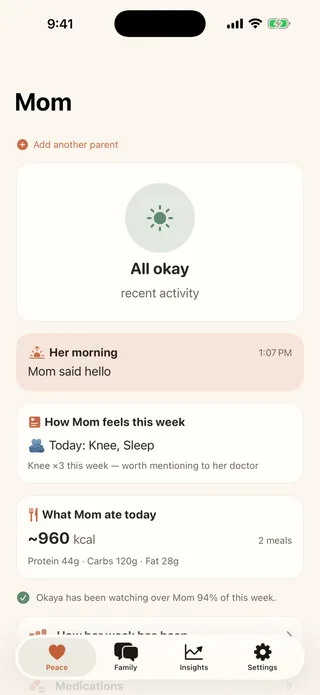
We built Okaya as exactly this kind of net: no camera, no microphone, no location history. She taps good morning; the family sees a quiet card; a free Silence Alarm climbs a family-defined ladder only when her phone shows no sign of her at all; and every sharing switch lives on her phone, revocable silently at any time. It is one way to implement the principles in this guide - the principles stand on their own.
Frequently asked questions
What is the best alternative to cameras for elderly parents? +
Consent-based signals: a daily one-tap check-in, phone-measured activity as a liveness signal, opt-in wellness categories, and an SOS button. They answer the daily is-she-okay question without filming anyone, so parents actually accept them.
Do medical alert pendants work for seniors living alone? +
Only if worn, and studies and family experience show many end up in a drawer because of what wearing one signals. Whatever system you choose, the parent's willingness to use it every day matters more than its features on paper.
How do I talk to my parent about safety without offending her? +
Start from her goals - staying in her own home - rather than your fears. Present options where she holds the controls, decide the escalation plan together, and accept a smaller footprint she will actually use over a bigger one she will resent.
Does Okaya record video or audio? +
No. Okaya has no camera or microphone monitoring and keeps no location history. Location is attached only to an SOS the parent triggers herself, if she enabled it.
This article is general information from Velora Health, not medical, legal or safety advice. Every family's situation is different; consult the professionals involved in your parent's care, and in an emergency always call your local emergency number.