Keeping a dog seizure diary your neurologist can actually use
Your vet asks how often the seizures happen, and you find yourself saying maybe once a month, though there was a bad week in spring. That answer is the reason a lot of epilepsy medication gets adjusted late. A diary fixes it, but only if it records the handful of things a neurologist is actually looking for.
After every seizure, record six things: date and time, how long the seizure itself lasted, whether it was one event or a cluster, what your dog was doing beforehand, how long recovery took, and any medication given. The pattern across months is what changes treatment; a single event almost never does. A seizure lasting more than five minutes, or repeated seizures without full recovery in between, is an emergency.
The six fields that matter
Most owners record too much of the wrong thing (a long description of how frightening it was) and too little of the right thing. A neurologist is reading for frequency, duration and clustering. Everything else is context.
| Field | Why it matters |
|---|---|
| Date and time | Frequency over months is the primary treatment signal. Time of day sometimes shows a pattern |
| Duration of the seizure | Not the recovery. The convulsion itself, timed. Over five minutes is an emergency |
| Single or cluster | Two or more seizures in 24 hours is a cluster and is managed differently from isolated events |
| What came before | Sleep, excitement, a missed dose, a new food, a thunderstorm. Patterns emerge only across many entries |
| Recovery time | How long until your dog was fully themselves again. Lengthening recovery is worth reporting |
| Medication given | Including any emergency medication your vet has prescribed for use at home, and whether it worked |
Time the seizure, not the fear
Almost everyone overestimates seizure duration, often by several times, because the experience is distressing. A ninety second seizure genuinely feels like five minutes. This matters because the five minute mark is a real clinical threshold, and a log full of overestimates makes the record less useful, not more.
The practical fix is to start a timer the moment it begins, before doing anything else. If that is not possible, note the clock time it started and the clock time it stopped, and write down that you estimated. An honest estimate marked as an estimate is far more useful than a confident wrong number.
Clusters are a different event, and must be logged as one
Two or more seizures within 24 hours is generally described as cluster seizures, and it is one of the main reasons a neurologist changes a treatment plan. If you log three seizures on one day as three separate entries with no link between them, the cluster is invisible in the record even though every fact is there.
So mark them explicitly. One entry that says three seizures across nine hours, with times, tells the story. Three unlinked entries do not. This is the single most common way a well kept diary still fails to say what it needs to say.
What counts as an emergency
Call your vet or an emergency clinic immediately if a seizure lasts more than five minutes, if seizures repeat without your dog fully recovering consciousness in between, or if your dog has an unusually high number of seizures in a short period. Prolonged seizure activity is a medical emergency in its own right, not just a bad episode, and it is treated urgently for that reason.
If your vet has prescribed an emergency medication for home use, the diary should record when you gave it and what happened next. That is information nobody can reconstruct later.
Medication levels belong in the same record
Dogs on long term anti-seizure medication usually have periodic blood tests to check drug levels and liver values. Keeping those results in the same place as the seizure log is what lets your vet line up a change in frequency against a change in level. Separately, note any missed or late doses honestly. A missed dose that precedes a seizure is genuinely useful information and nobody is judging you for it.
What the neurologist is looking for
- Frequency trend. Are seizures becoming more common over months, stable, or less frequent since the last change
- Clustering. Whether events arrive alone or in groups
- Duration trend. Whether individual seizures are getting longer
- Response to the current plan. What changed after the last dose adjustment
- Recovery quality. Whether your dog returns fully to normal between events
Notice that none of these can be answered from one seizure. They are all comparisons, which is why the boring months of logging nothing dramatic are the ones that make the record work.
Video is worth more than description
If it is safe and you are not needed to protect your dog from injury, a short phone video of an event is more diagnostically useful than any written description. Some things that look like seizures are not seizures, and a neurologist can often tell from footage what no amount of writing conveys. Never put yourself between a seizing dog and your own safety to get it, and never put your hands near the mouth.
Making the record survive real life
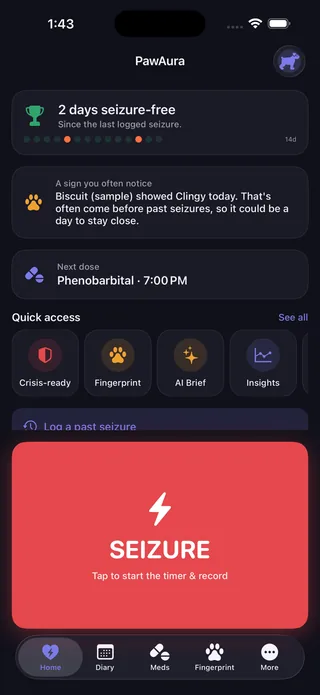
A seizure at 3am does not get written up neatly. The diary that works is the one where logging an event takes seconds on a phone in the dark, and where the summary for the next appointment builds itself from those entries. PawAura is built around exactly that: one tap to start a timer, cluster detection, medication tracking, and a brief you can hand to your vet.
Frequently asked questions
What should I write down after my dog has a seizure? +
Six things: date and time, how long the seizure itself lasted, whether it was a single event or part of a cluster, what your dog was doing beforehand, how long recovery took, and any medication given. The pattern over months is what changes treatment.
How long is too long for a dog seizure? +
A seizure lasting more than five minutes is a medical emergency, as is a series of seizures where your dog does not fully recover consciousness between them. Contact your vet or an emergency clinic immediately in either case.
What are cluster seizures in dogs? +
Two or more seizures within 24 hours. Clusters are managed differently from isolated seizures, so they need to be logged explicitly as a cluster rather than as separate unlinked events, or the pattern disappears from the record.
Do I need to record seizures if my dog is already on medication? +
Yes, and arguably more so. The whole point of the record is to show whether the current plan is working: frequency, duration and clustering before and after each dose change are what your vet uses to decide what to do next.
Should I film my dog having a seizure? +
If it is safe to do so and your dog does not need you to prevent injury, a short video is more useful to a neurologist than a written description, because some events that look like seizures are something else. Never compromise your own safety or put your hands near the mouth.
Can an app diagnose my dog's epilepsy? +
No. PawAura records what you observe and organises it for your vet. Diagnosis, medication choice and dosing decisions belong to your veterinarian or veterinary neurologist.
This article is general wellness information from Velora Health, not medical advice, diagnosis or treatment. Always consult a qualified healthcare professional about your symptoms and before changing anything about your care.