IRIS stages in cats, explained in plain language
Your vet says the word stage and hands you a diagnosis with a number attached, and the number itself explains nothing. Here is what IRIS staging is actually measuring, what each stage tends to mean day to day, and why the number you get today is not necessarily the number you will have next year.
IRIS staging is how vets classify feline chronic kidney disease, from the International Renal Interest Society. It runs from stage 1 (mild, often found by accident) to stage 4 (advanced). The stage is set mainly from two blood values, creatinine and SDMA, then refined with substages for urine protein and blood pressure. It is a snapshot, not a sentence: many cats are stable in an early stage for years, and the stage can be revised at any recheck as new labs come in.
What is actually being measured
Creatinine and SDMA are waste products that healthy kidneys filter out of the blood. As kidney function declines, both tend to rise, and IRIS uses them together because they behave differently: SDMA often rises earlier, while creatinine is affected by muscle mass, which can make it look falsely reassuring in a thin or muscle-wasted cat. Your vet is reading both against your cat's own history, not a single cutoff in isolation.
The four stages, in practical terms
| Stage | What it broadly means | What usually happens |
|---|---|---|
| Stage 1 | Kidney damage is present but blood values are close to normal | Often found incidentally. Monitoring, and addressing any underlying cause found |
| Stage 2 | Mild loss of function, may show early signs like more thirst | Usually the point a renal diet is discussed |
| Stage 3 | Moderate loss of function, symptoms more likely to be noticeable | Diet plus management of complications: phosphorus, blood pressure, protein loss |
| Stage 4 | Advanced loss of function | Intensive management, often including subcutaneous fluids at home |
Exact numeric cutoffs are deliberately left out here. IRIS updates its reference ranges, a single reading can be affected by hydration and stress on the day of the blood draw, and your vet is the one applying the current guidelines to your cat's specific labs. Ask them directly what values put your cat in their stage; it is a normal question and a good one.
Substages: the two numbers that refine the picture
Two cats in the same stage can be managed differently because of their substage. Proteinuria (protein leaking into urine, measured as a UPC ratio) matters because protein loss through damaged kidneys is itself linked to faster progression, and is often treatable. Blood pressure matters because untreated hypertension damages the kidneys, the eyes and the heart further, and it is easy to miss without measuring it directly, since cats rarely show obvious signs of high blood pressure.
Why the stage can change
A stage is a reading of where things stand at that recheck, not a fixed prognosis. It can improve if a treatable cause is addressed (a urinary infection, dehydration, certain medications). It can also be revised upward as labs are repeated over months. This is exactly why a single number matters less than the trend across several rechecks, and why keeping every lab result in one place, rather than scattered across visit summaries, is worth the effort.
Questions worth asking at the next recheck
- What stage is my cat today, and what were the creatinine and SDMA values behind it?
- Is proteinuria present, and does it need treatment on its own?
- Has blood pressure been checked, and what was it?
- What changed since the last set of labs, better or worse?
- What would make you reconsider the treatment plan?
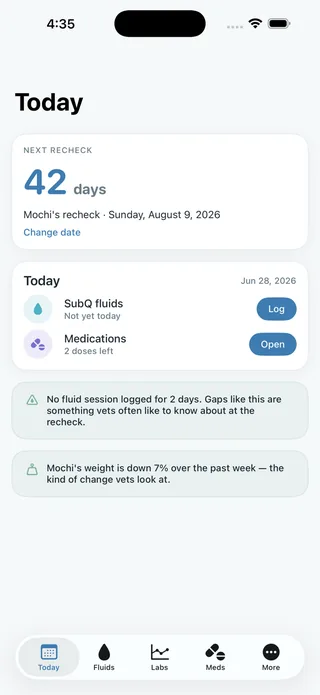
RenalPaw keeps every lab result charted against recheck dates and gives you an estimate of the stage from what you enter, always to confirm with your vet rather than to replace that conversation.
Frequently asked questions
What are the IRIS stages of cat kidney disease? +
A four-stage classification from the International Renal Interest Society, based mainly on blood creatinine and SDMA and refined with substages for urine protein and blood pressure. Stage 1 is mild, stage 4 is advanced.
Can a cat's IRIS stage go down, meaning improve? +
Yes, if a treatable cause is contributing, such as a urinary infection or dehydration at the time of testing. Chronic kidney disease itself does not reverse, but the measured stage can shift with the underlying picture.
Why did my vet mention SDMA as well as creatinine? +
SDMA often rises earlier than creatinine and is less affected by muscle mass, so the two together give a fuller picture than either alone, particularly in a thin or older cat.
What is proteinuria and why does it matter for staging? +
It means protein is leaking into the urine through damaged kidneys, measured as a UPC ratio. It is used as a substage because it is linked to faster progression and is often treatable on its own.
Does a high IRIS stage mean my cat is suffering? +
Not necessarily. Many cats in stage 2 or even stage 3 feel and act well with appropriate management. Stage describes kidney function on bloodwork, not directly how your cat feels day to day.
This article is general wellness information from Velora Health, not medical advice, diagnosis or treatment. Always consult a qualified healthcare professional about your symptoms and before changing anything about your care.