How to track Sjogren's symptoms, and make every appointment count
Sjogren's syndrome is hard to put into words at a 15-minute appointment. Dryness, fatigue and pain shift from day to day, and "I have good days and bad days" rarely gives your rheumatologist enough to work with. Consistent tracking changes that. Here is a simple, sustainable way to do it.
Why tracking matters for Sjogren's
Sjogren's is a chronic autoimmune condition whose hallmark is sicca - dry eyes and dry mouth - usually alongside fatigue and joint pain. Because symptoms fluctuate, memory is a poor record. A few weeks of daily data turns vague impressions into a trend your clinician can actually act on.
Track the three ESSPRI numbers every day
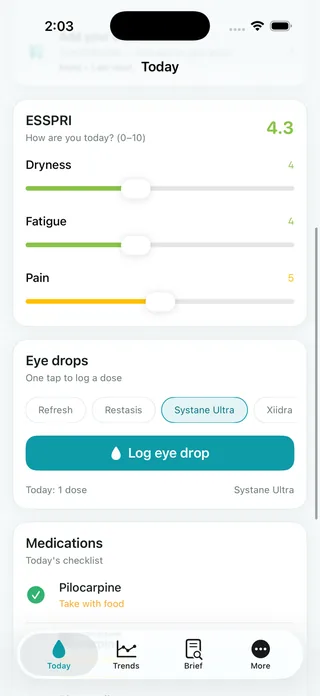
ESSPRI (the EULAR Sjogren's Syndrome Patient Reported Index) is a validated 0 to 10 scale your rheumatologist already understands. Each day, rate three things:
- Dryness - eyes, mouth, and other affected areas
- Fatigue - how depleted you feel
- Pain - joint or muscle discomfort
Logging these takes seconds, and the average over time is far more useful than any single day. An app like Dew keeps the running trend so you do not have to do the maths.
Find the eye drops that actually help
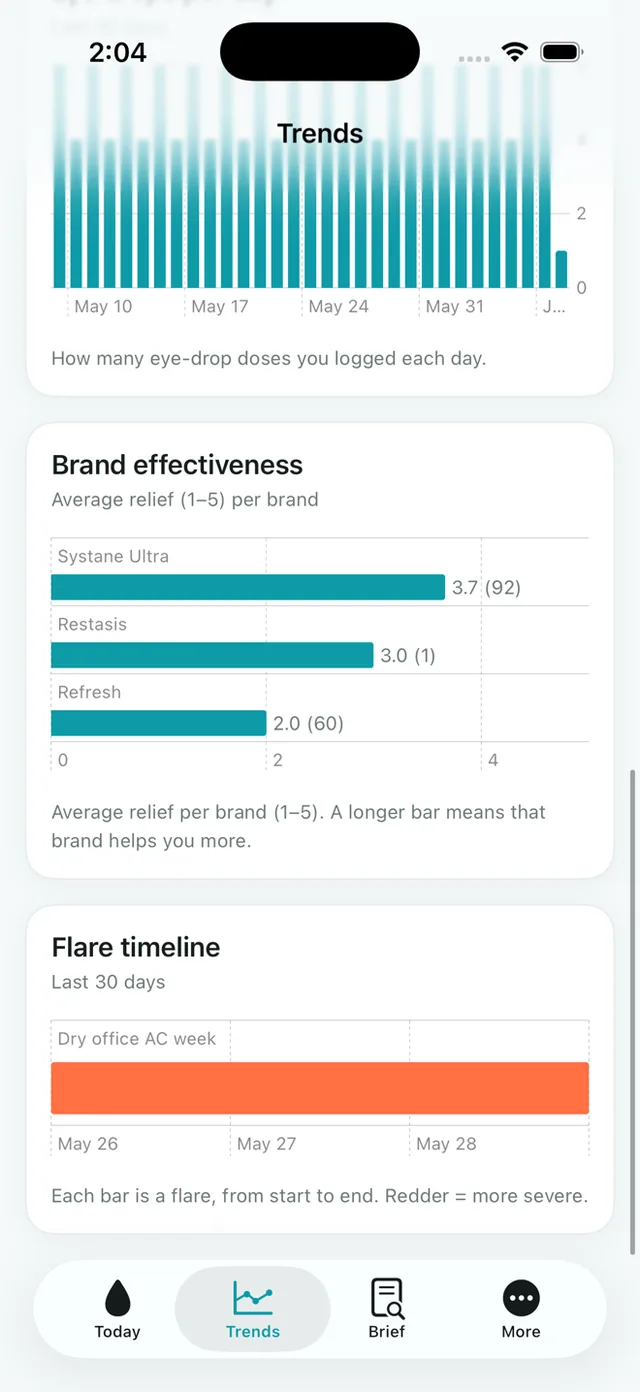
Most people with dry eye cycle through several brands - Systane, Refresh, Restasis, Xiidra - without ever knowing which one works best for them. The trick is to rate relief shortly after each dose (a simple 1 to 5), then compare the average per brand over a few weeks. The winner is often a surprise, and it is a concrete thing to discuss with your eye doctor.
Log flares and their triggers
When symptoms spike, note the date, severity and what was going on: dry office air, air conditioning, wind, long screen sessions, poor sleep or stress. Over time, patterns emerge. Dry air is a common one, which is why tracking local humidity alongside your symptoms can be revealing.
Keep your labs and red flags in one place
Bring your serology (such as anti-Ro/SSA and anti-La/SSB, ANA) and any dry-eye scores (OSDI, Schirmer) together with your symptom trend. Also keep a short watchlist of things worth flagging to a doctor - persistent gland swelling or lumps - because people with Sjogren's have a higher-than-average risk of lymphoma. This is awareness, not alarm.
What to bring to your rheumatologist
- Your ESSPRI trend over the last month or two
- Which eye drops gave the most relief, with numbers
- A short list of your worst flares and likely triggers
- Medication adherence and any side effects
- Recent lab values, in one place
- Three or four questions you want answered
A one-page summary like this lets the appointment focus on you, not on remembering. Dew can generate exactly this kind of brief automatically each month.
Frequently asked questions
What is the ESSPRI score? +
ESSPRI is the EULAR Sjogren's Syndrome Patient Reported Index, a validated 0 to 10 scale covering dryness, fatigue and pain. It is widely used in rheumatology to follow how someone with Sjogren's is doing over time.
How long should I track before an appointment? +
Around four weeks of daily logging gives a meaningful trend. Even two weeks is far better than relying on memory.
Can an app diagnose Sjogren's? +
No. Tracking apps, including Dew, are wellness tools that help you record symptoms and spot patterns. Diagnosis and treatment are for a qualified clinician.
Does dry weather make Sjogren's worse? +
Many people find low humidity worsens dryness. Logging humidity next to your symptoms helps you see whether that is true for you.
This article is general wellness information from Velora Health, not medical advice, diagnosis or treatment. Always consult a qualified healthcare professional about your symptoms and before changing anything about your care.